How Long Can Party Food Sit on the Buffet Table Before It Has to Be Tossed?
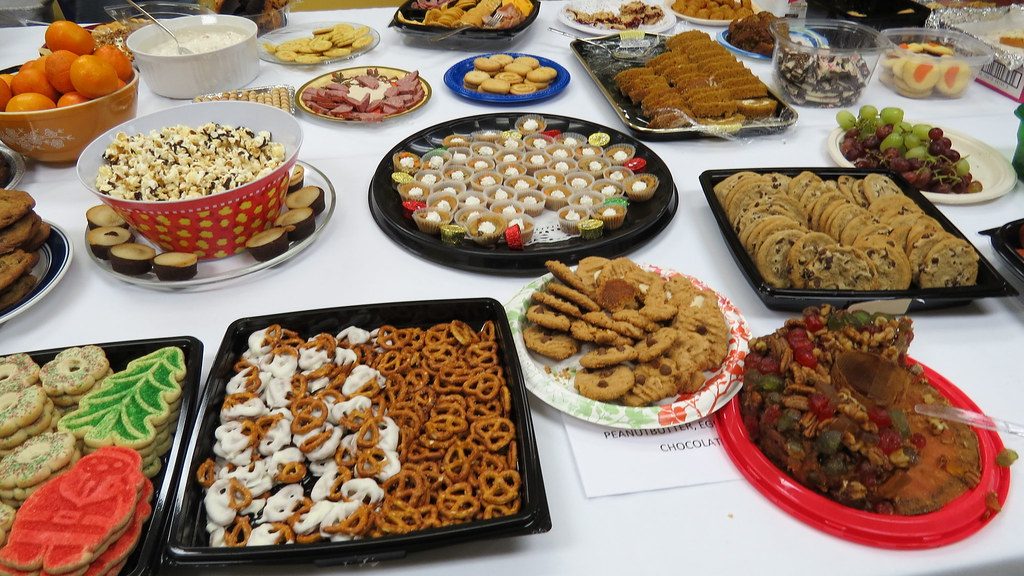
Photo: Accretion Disc via Flickr (CC BY 2.0) · license
Two hours: perishable party food that isn’t kept hot or cold should be thrown out after 2 hours at room temperature, or after 1 hour if it’s above 90°F. Every minute at room temperature counts, not just party time, and reheating doesn’t reset the clock.
The 2-hour and 1-hour limits are FDA’s rule for home buffets, and most hosts have heard some version of it. Where parties go wrong is in how the rule gets applied: when the clock starts, what counts as “keeping it hot,” and what restaurants are allowed to do that home kitchens aren’t. Three common beliefs cause most of the trouble.
Belief: “The two hours start when the guests arrive”
FDA’s rule counts the time perishable food is left out at room temperature, and the party’s start time has nothing to do with it. A tray of deviled eggs set out at 5:30 for a 6:00 party has already used half an hour before the doorbell rings. Time a dish spends sitting on the counter before it reaches the table is room-temperature time too.
Dishes guests bring are easier to miscount. The Academy of Nutrition and Dietetics puts it plainly: if guests are bringing food, the clock starts ticking when they walk out their own door. A potato salad that rode 30 minutes in the car without a cooler arrives with 90 minutes left, not two hours. The Academy’s advice for the trip is to pack cold dishes with ice or cooling packs in an insulated cooler and hot dishes in an insulated container, and to keep cold dishes below 40°F and hot dishes above 140°F.
The 1-hour version applies whenever the buffet sits somewhere above 90°F, such as a backyard table on a hot afternoon. FDA’s wording ties the shorter limit to where the buffet is held, not to the season.
Belief: “Restaurants leave buffets out for hours, so it must be fine”
Restaurant buffets work under different rules, and those rules are stricter than they look. When a restaurant leaves food out without temperature control, it uses a Food Code provision called “time as a public health control.” Minnesota’s version of that rule shows the conditions that come with it:
- The 4-hour option: the food has to start below 41°F or above 135°F when it comes out, and it has to be marked with the exact time that is 4 hours later. By that time it must be served or discarded. Food in an unmarked container, or marked past 4 hours, goes in the trash.
- The 6-hour option: this applies to cold food only. It must start at 41°F or below, and it is monitored so it never rises above 70°F. It is thrown out the moment it passes 70°F or reaches 6 hours.
The longer limits are a trade: a kitchen gives up temperature control in exchange for a known starting temperature, a written deadline, and a hard discard at the end. Packing it up for tomorrow isn’t one of the outcomes the rule allows. That rule is part of the code for food businesses. For home buffets, FDA’s guidance is the 2-hour rule, and labeling a platter doesn’t turn it into a 4-hour dish. Local rules vary, so treat Minnesota’s as an example, not as your county’s code.
Belief: “If I heat it until it’s steaming, it’s safe again”
This is the belief that does the most damage, because it feels like common sense. Cooking kills bacteria. It doesn’t destroy the toxins some of them leave behind.
The University of Nebraska–Lincoln explains how this works with Staphylococcus aureus, a bacterium that normally lives on people’s skin and in their noses. Staph multiplies quickly in food held at room temperature and produces a toxin that is very resistant to heat, refrigeration, and freezing. Its usual vehicles read like a party menu: egg, tuna, chicken, potato, and macaroni salads, cream-filled pastries and cream pies, and sliced meats. Symptoms can begin 30 minutes to 8 hours after eating.
CDC’s report on a 1986 country-club buffet in New Mexico shows how this plays out at scale. About 855 people were served. Illness was tied to turkey, dressing, and gravy, and the turkey had cooled for 3 hours at room temperature after cooking. The report’s conclusion is blunt: the toxin is heat stable, and reheating foods will not prevent the illness.
South Dakota State University Extension makes the same point for other bacteria: the Bacillus cereus toxin is heat stable up to 250°F, and the heat needed to destroy these toxins will most likely never be reached in a home kitchen. Rice is the classic example, covered in why leftover rice makes people sick when other leftovers don’t.
Reheating to 165°F, as Purdue Extension advises, is still the right step for leftovers that were refrigerated on time. It just can’t rescue food that missed the window. USDA notes that the bacteria behind food poisoning generally don’t change how food looks, smells, or tastes, so go by time and temperature, never by a sniff test.
What actually stops the clock
FDA’s 2-hour rule applies “unless you’re keeping it hot or cold.” Each of those has a number:
- Hot means 140°F or warmer, measured inside the food. Chafing dishes, slow cookers, and warming trays all work, but FDA warns that some warmers only hold food at 110°F to 120°F. A dish on one of those is on the 2-hour clock like everything else. Check the label, and check the food with a thermometer.
- Cold means 40°F or colder. FDA’s method is to set plates of cold food on ice. Purdue Extension adds that cold dishes should stay in a cooler with ice or gel packs until just before serving.
Topping off a half-empty bowl breaks the system even when temperatures are right. FDA advises against adding new food to a dish that’s already been out, because bacteria from guests’ hands can get into it and bacteria multiply at room temperature. The fresh dip ends up sharing the old dip’s clock.
The party clock, worked out
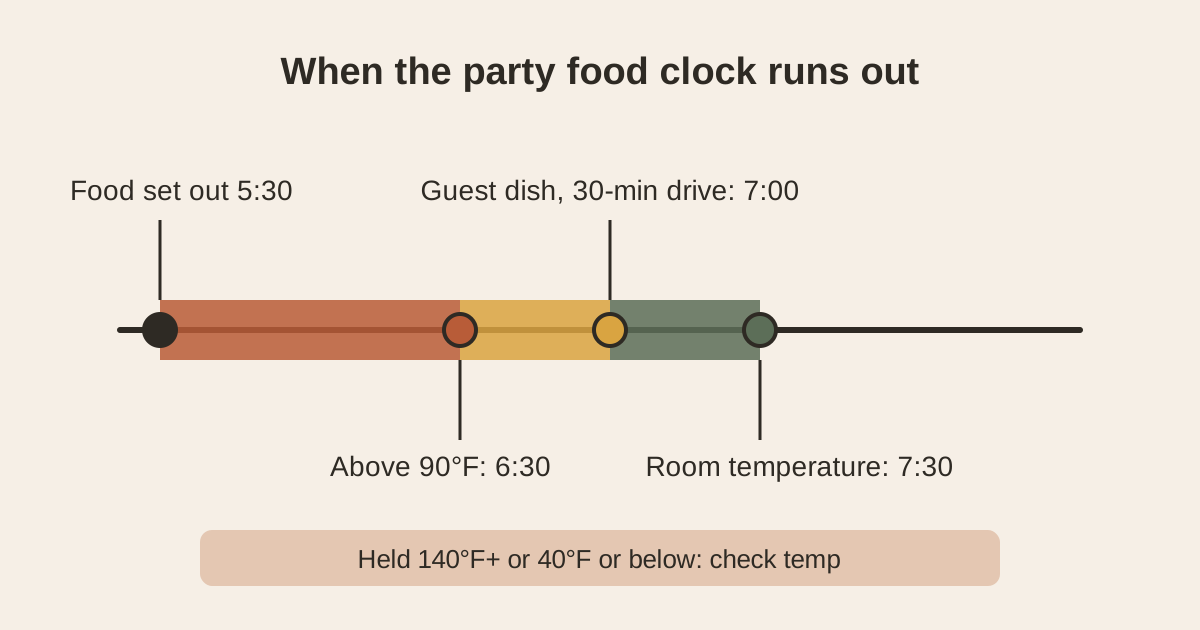
Here is one sample party: food comes straight from the fridge or oven onto the table at 5:30 p.m., and the party runs until 9:30 p.m. If a dish sat on the counter first, start its clock earlier. The time limits come from FDA and the Academy of Nutrition and Dietetics, and the times are simple addition.
| How the dish is held | Time limit | Arithmetic | Swap or toss by |
|---|---|---|---|
| Room temperature, 90°F or below | 2 hours | 5:30 + 2:00 | 7:30 p.m. |
| Room or patio above 90°F | 1 hour | 5:30 + 1:00 | 6:30 p.m. |
| Guest’s dish, 30-minute drive without cooling | 2 hours, minus the drive | 2:00 − 0:30 = 1:30 on the table; 5:30 + 1:30 | 7:00 p.m. |
| On a warmer that only reaches 110–120°F | Same as room temperature | 5:30 + 2:00 | 7:30 p.m. |
| Chafing dish or slow cooker measuring 140°F or more | Kept hot, so FDA’s 2-hour discard doesn’t apply | Check with a thermometer during the party | Once it reads below 140°F it is no longer held hot; swap it out |
| Cold platter on ice measuring 40°F or less | Kept cold, so FDA’s 2-hour discard doesn’t apply | Check with a thermometer during the party | Once it reads above 40°F it is no longer held cold; swap it out |
For the swap plan, divide the party length by the time limit. A 4-hour party with a 2-hour limit means 4 ÷ 2 = 2 rounds of each room-temperature dish: one platter at 5:30 and a fresh one at 7:30. FDA’s version is to prepare several small platters ahead of time, keep the backups cold in the refrigerator or hot in an oven at 200°F to 250°F, and swap whole dishes instead of refilling. If the patio is over 90°F, the same 4 hours takes 4 ÷ 1 = 4 rounds. At that point, moving the food indoors or onto ice is usually easier than making more platters.
After the party
Anything that went past its limit gets thrown out, even if it looks untouched. FDA says perishables left out more than 2 hours (1 hour above 90°F) should be discarded, and Purdue Extension says leftovers should be refrigerated at 40°F or below within two hours. Food that was swapped in at 7:30 and comes off the table at 9:00 is still inside its window and can go straight into the fridge, ideally in shallow containers so it cools quickly.
From there, normal leftover rules apply, including reheating to 165°F. The full set of storage rules is in leftovers, thawing, and fridge storage in one place, and the day-by-day limits are in how long leftovers really last.
The simplest party habit comes straight from the table above. Write the swap time on a sticky note next to each platter when it goes out. It borrows the idea of the time label restaurants must use when they hold food without temperature control, but at home the deadline stays 2 hours.
Sources
- Serving Up Safe Buffets (FDA) — 2-hour and 1-hour rules, 140°F and 40°F holding, warmers that only reach 110–120°F, ice, small platters, backups at 200–250°F, no topping off
- Beat the Buffet Blues (Academy of Nutrition and Dietetics) — the clock starts when guests leave home, packing dishes for transport
- Food Safety for Buffets and Parties (Purdue Extension) — cold dishes in a cooler until serving, refrigerating leftovers within two hours, reheating to 165°F
- 4626.0408 Time as Public Health Control (Minnesota Administrative Rules) — restaurant 4-hour and 6-hour conditions, marking, discard
- Staphylococcal Food Poisoning from Turkey at a Country Club Buffet (CDC MMWR) — the 1986 buffet outbreak, 3 hours at room temperature, heat-stable toxin
- Staphylococcus aureus (University of Nebraska–Lincoln) — where staph comes from, the foods it’s tied to, toxin resistance, onset time
- Re-heating and Re-eating Food (SDSU Extension) — home reheating can’t destroy heat-stable toxins, B. cereus toxin stable to 250°F
- Refrigeration and Food Safety (USDA FSIS) — food-poisoning bacteria generally don’t change how food looks, smells, or tastes
Written and reviewed by peter.bae for Hearth & Habit


Comments
Post a Comment