The 15-Minute Weekly Home Reset: A Simple Routine That Keeps Your House Under Control

Once a week, set a 15-minute timer, carry one basket through the rooms you use most, and put every stray item back. Missing one week does little damage; skipping often does.
The routine itself is simple, and most versions online agree on it. What they leave out is why these routines often fall apart within a few weeks, what the research on habits says about missed weeks, and how to fold in the monthly checks a house needs without letting 15 minutes turn into 45. That’s what most of this guide covers.
The 15-minute core
Set a timer. Grab an empty laundry basket as your relocation bin for anything that lives in another room. Don’t deliver anything until the end.
| Minutes | Room | What to do |
|---|---|---|
| 1–4 | Entry and living room | Trash out, remotes and blankets corralled, shoes paired, strays into the basket |
| 5–8 | Kitchen | Dishes away, quick counter and table wipe, junk mail recycled, fridge sweep (below) |
| 9–11 | Main bathroom | Sink and faucet wiped, counter cleared, hand towel swapped |
| 12–14 | Bedroom | Nightstand and dresser cleared, clothes chair emptied |
| 15 | Whole house | Basket run: everything back where it lives |
Batching the put-backs into one walk at the end, instead of twenty trips mid-room, is what makes the time fit. Two people splitting the rooms each take a share of the pass.
The goal is a baseline, not a clean house. Flat surfaces are mostly clear, floors are walkable, and tomorrow-you can find things. Vacuuming, mopping, and scrubbing are a different job on a different day. The moment the reset absorbs them, it starts running long and you start skipping it.
Why reset routines fall apart, and what the research says
A common way a weekly reset ends isn’t that it’s hard. It’s missing one week, deciding the habit is broken, and never restarting. The research points the other way.
One missed week does little damage
The best-known study of real-world habit formation comes from Phillippa Lally and colleagues. The British Psychological Society’s summary reports that 82 people repeated a chosen behavior daily for 84 days and rated how automatic it felt. The finding most relevant here is that a single missed day had little impact on later gains, but many missed repeats had a cumulative effect.
So the working rule for the reset is “never skip twice.” If Sunday falls apart, do it Monday, or do a five-minute version of just the basket run. Don’t wait for next week and don’t start over.
“21 days” is the wrong expectation, and weekly is slower still
The same study found the average time to reach maximum automaticity was 66 days, ranging from 18 days to a projected 254 days. Those were daily behaviors. A weekly routine gets far fewer repetitions in the same stretch of calendar:
- Daily habit over 66 days: 66 repetitions
- Weekly reset over 66 days: 66 ÷ 7 ≈ 9 repetitions
The study didn’t test weekly routines, so nobody can tell you how many weeks the reset takes to feel automatic. The arithmetic does tell you not to expect it in a month. The study also found that exercise behaviors took about one and a half times as long to plateau as eating or drinking ones. A multi-room routine is closer to the complicated end, so expect it to take longer than a simple habit before it runs on its own.
One limitation is worth knowing: participants rated their own automaticity, so “automatic” here means “felt automatic,” not something measured from outside.
Pick one cue and keep it
A routine that has to be remembered fresh each week competes with everything else that week. Attach the reset to something that already happens weekly, at the same time, such as before a Sunday-evening show, after Saturday coffee, or right after the trash goes out.
If you’re choosing a day, weekends are when more people already do housework. The Bureau of Labor Statistics’ American Time Use Survey found 40% of people did housework on an average weekend day, compared with 35% on weekdays.
Does a cluttered house actually affect you?
You’ll see “clutter raises cortisol” in many organizing articles. The study usually behind it is narrower. Darby Saxbe and Rena Repetti had 60 dual-income spouses give recorded tours of their homes and counted the words they used. Wives who used more words like cluttered and unfinished had flatter daily cortisol curves, a stress-hormone pattern associated with worse health, and their depressed mood rose over the day. Wives who described their homes as restful showed the opposite pattern.
It’s a correlation, not proof that clutter causes stress, and the cortisol finding is for wives. It does suggest that how you see your home is part of the payoff, not only how it looks to guests.
Three jobs the reset handles better than most routines
The fridge sweep, with dates
Minute 5–8 is a good moment to pull old leftovers. The catch is that a weekly look can’t enforce the USDA’s limit on its own: cooked leftovers keep 3 to 4 days in the refrigerator at 40°F or below.
Here’s how that plays out with a Sunday reset:
- Chili made Sunday reaches the end of its 4-day window on Thursday, so a weekly sweep the next Sunday finds it three days later.
- Soup made Wednesday is 4 days old on Sunday, so it goes during the sweep.
The fix is a strip of masking tape with the cooking date on every container, plus a quick look on the day it expires. The weekly sweep is the backstop, not the system. Don’t judge leftovers by smell, since the USDA notes that the bacteria behind food poisoning usually don’t change how food smells. The full timelines are in our guide to how long leftovers really last.
The paper pile, cut at the source
Recycling junk mail every week treats the symptom. The Federal Trade Commission lists two free or cheap ways to shrink what arrives:
- Marketing mail: register at DMAchoice.org. The FTC says it costs $6 online and lasts 10 years, or $7 by mail, and that it stops most but not all promotional mail.
- Prescreened credit and insurance offers: opt out at optoutprescreen.com or by calling 1-888-567-8688. You can opt out for five years, or permanently by signing and returning the form they send.
Each is a one-time job, so it fits as one week’s add-on (see the rotation below). Bills and forms that do need action go in one tray and get handled outside the reset.
Dead batteries in the basket
Spent batteries tend to surface during a reset, in drawers, remotes, and toys. Don’t toss them. The EPA says lithium-ion, lithium single-use, and button or coin batteries never go in household trash or recycling bins, because they’re a fire hazard. Keep a jar for them, put electrical tape over the terminals or bag each one, and take the jar to a battery recycler, a retailer with take-back, or a household hazardous waste drop-off when it fills.
The four-week rotation
A house also needs a few checks every month. Bolted onto the reset all at once, they make it run long. Rotate one per week instead, and the reset stays close to its 15 minutes.
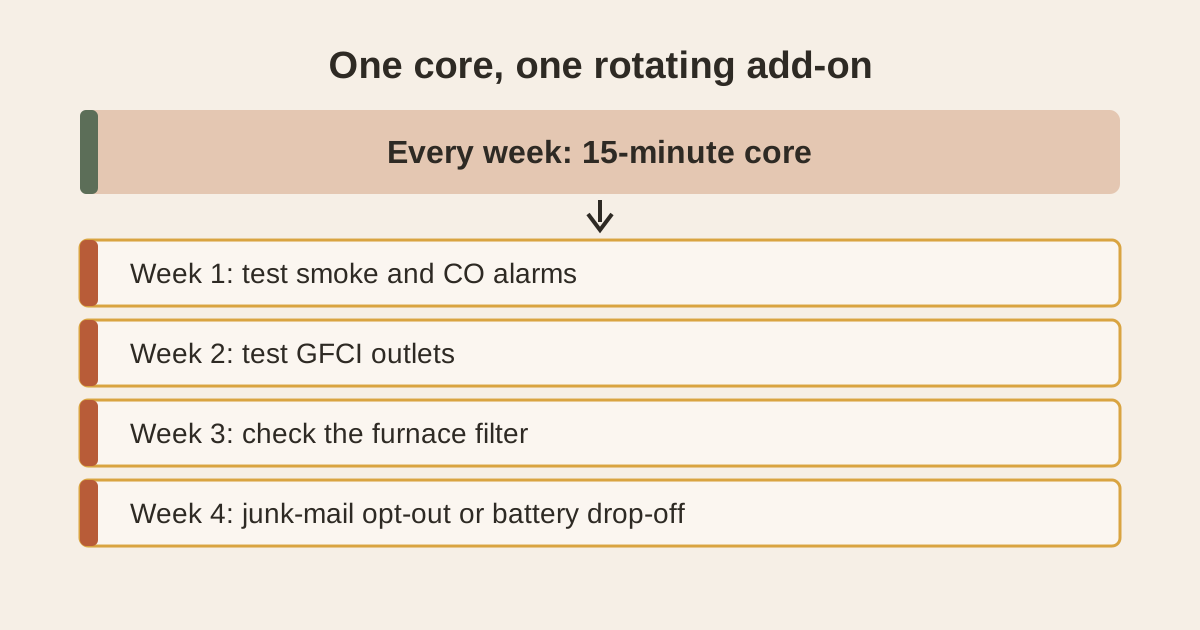
| Week | Core (every week) | Add-on | Why monthly |
|---|---|---|---|
| 1 | 15-minute pass, fridge sweep, basket run | Press the test button on every smoke and CO alarm | NFPA says test smoke alarms monthly, and CO alarms too |
| 2 | Same | Press TEST, then RESET, on each GFCI outlet | CPSC says test GFCI outlets monthly |
| 3 | Same | Look at the furnace filter | ENERGY STAR says check it monthly and change it at least every 3 months |
| 4 | Same | One junk-mail opt-out, or drop off the battery jar | One-time jobs that keep the reset short later |
In a five-week month, use the extra week to catch up on whichever add-on you skipped. The alarm and GFCI tests are quick. If the filter is due, our furnace filter guide covers sizes, MERV ratings, and which way the arrow points.
While you’re at the alarms, check how old they are. NFPA says to replace the whole smoke alarm every 10 years, not just its battery.
Bathroom wipe: what it does and doesn’t do
The minute-9 wipe cleans. It doesn’t disinfect. The EPA’s distinction is that soap and water remove germs, while disinfecting takes an EPA-registered disinfectant left on for the full contact time on its label. That’s fine for a weekly reset. Save the disinfecting for the deeper clean.
If you keep a bleach product and a toilet-bowl or lime-scale cleaner under the same sink, never use them together. Many of those cleaners are acidic, and mixing bleach with acids or ammonia releases toxic gas. Use one, rinse, then the other.
When the reset keeps running long
The first few resets often run long because you’re catching up on old mess. If it still runs well past 15 minutes after a month, the reset isn’t the problem. It can fix placement but not volume.
Two things lower the baseline it returns you to:
- Fewer things landing in the basket. The one-touch rule, putting things all the way away the first time you pick them up, shrinks the basket during the week.
- Fewer things, period. A separate decluttering effort, starting with one drawer, keeps the reset from just shuffling excess around.
FAQ
Is once a week really enough?
For things being out of place, it works for many households, especially paired with dishes and a counter wipe after dinner most days. Homes with young kids may do better with two shorter passes, for example Wednesday and Sunday. Two passes a week also double the repetitions, which may help the habit form sooner.
How do I get the rest of the household to do it?
Give each person a zone and the same start time, and keep the timer short enough that it isn’t a negotiation. Kids can own the basket run at minute 15. The ATUS figures show women spend more time on household activities than men on the days they do them (2.8 hours vs. 2.1), so a split reset is also a fairer one.
Sources
- How to form a habit (British Psychological Society) — 66-day average and 18–254-day range, minimal effect of a single missed day, longer plateau for exercise than for eating or drinking behaviors, self-report limitation
- No place like home: home tours correlate with daily patterns of mood and cortisol (Saxbe & Repetti, Europe PMC record) — 60 spouses’ home tours, clutter language and wives’ cortisol and mood
- How To Stop Junk Mail (FTC) — DMAchoice cost and 10-year term, prescreened-offer opt-out options and phone number
- American Time Use Survey Summary (BLS) — weekend vs. weekday housework, time spent by women and men
- Used Household Batteries (US EPA) — which batteries stay out of the trash, taping terminals, drop-off options
- Leftovers and Food Safety (USDA FSIS) — 3–4 day refrigerator limit at 40°F or below
Written and reviewed by peter.bae for Hearth & Habit · Last reviewed October 11, 2026


Comments
Post a Comment