Clutter Keeps Coming Back? Match the Problem to the Fix
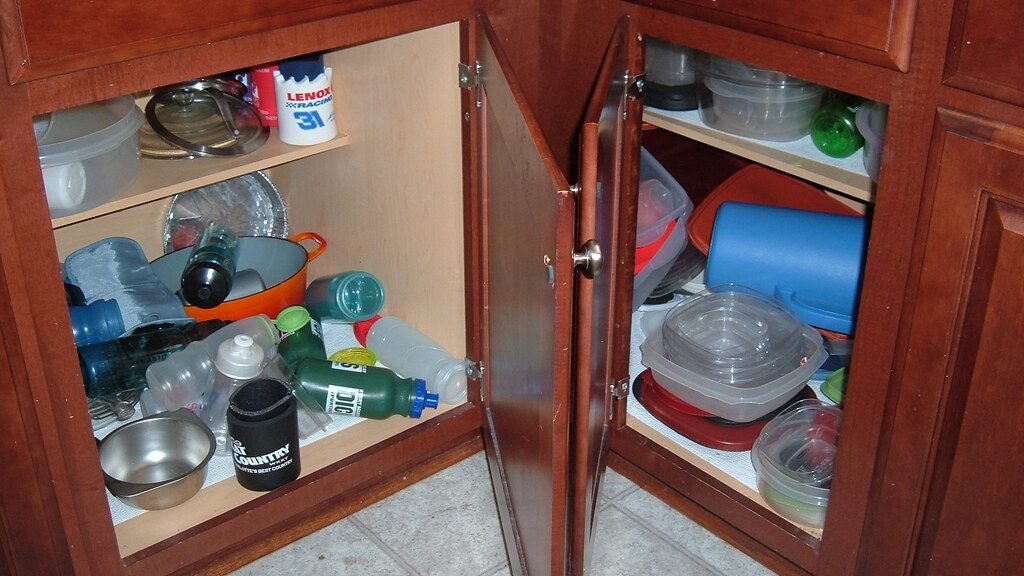
Photo: Rubbermaid Products via Flickr (CC BY 2.0) · license
Clutter keeps coming back because its cause is still in place: things with no home, more things than your storage holds, or tidy-ups too far apart, often with one person doing all of them. Sorting the pile that came back tells you which one you have.
Cleaning harder treats all three the same way, which is why the pile returns. The audit below is quick and turns “I’m just messy” into a specific fix. At the end is the short list of signs that it’s more than clutter, which needs a different kind of help.
The pile audit: sort what came back by why it’s there
Pick the one spot that refills fastest: the kitchen counter, the chair in the bedroom, the bottom stair. Take everything off it and sort each item into one of four groups.
| Group | The test | What it means | The fix |
|---|---|---|---|
| A. No home | You can’t name the one place it belongs | The system has a gap | Assign a home before buying any organizer |
| B. Home is full | It has a home, but the home is already stuffed | You own more than the space holds | Reduce the volume in that home |
| C. Not put back | It has a home with room, and it just never went back | The rhythm is off | A shorter, more regular reset |
| D. Someone else’s | It belongs to another person in the house | The reset isn’t shared | Assign it to its owner |
Count each group. The biggest one is your main problem, and it’s the one to fix first.
A worked example
Here’s a hypothetical counter pile of 24 items:
- A, no home: 11 items (mail, a charger, receipts, a library book)
- B, home is full: 3 items (mugs that don’t fit in a crowded cabinet)
- C, not put back: 8 items (scissors, tape, sunglasses)
- D, someone else’s: 2 items
No home is the biggest group: 11 ÷ 24 = 0.46, or about 46% of the pile. Not put back comes second at 8 ÷ 24 = 0.33, about 33%. Buying bins or doing a bigger purge wouldn’t fix this counter. Giving mail and chargers a real address would, followed by a daily habit for the rest.
Run the same count on your own pile. If one group is more than half, you have a single problem. If two groups are close, fix the larger one first, then recount.
If most of it has no home (Group A)
Group A clutter gathers where things stop moving: by the door, on the kitchen counter, in one drawer. Each item needs one specific address, picked where you actually use it, not where it looks tidiest. Mail gets a tray or a slot by where you open it. Chargers get one spot near an outlet. Keys, wallet, and bag get one landing place by the door you really use.
Then keep the address working with the one-touch rule. When you pick something up, take it all the way home instead of setting it down “for now.”
Old batteries often turn up in this pile. Keep lithium-ion and button or coin batteries out of the household trash, since the EPA flags them as a fire hazard. Tape the terminals and take them to a battery drop-off.
If the homes are full (Group B)
No system fits more than the storage holds. If Group B wins, reduce the volume of that one home: the stuffed cabinet, the closet, the overflowing drawer. Don’t start on the whole house. If starting is the hard part, begin with a single drawer and finish it before moving on.
If you plan to donate and deduct, know the IRS rule first. You can’t deduct donated clothing or household items unless they’re in “good used condition or better.” The one exception is a single item you deduct more than $500 for, which needs a qualified appraisal and Form 8283, Section B. The IRS counts furniture, electronics, appliances, and linens as household items. Outside that exception, worn-out items you were planning to write off don’t qualify.
If things have room but never go back (Group C)
Group C means the homes are fine and the gap between tidy-ups is too long. A short, regular pass beats an occasional marathon. The 15-minute weekly home reset puts out-of-place items back before the backlog grows.
If the house is tidy on Sunday night and messy again by Tuesday, the reset is too infrequent for how fast things move in your home. Our piece on why a house gets messy again two days after cleaning covers how to set a daily loop for the spots that move fastest.
If a lot of it belongs to someone else (Group D)
A big Group D can mean the tidying falls to one person. National data shows the work isn’t split evenly. In the 2025 American Time Use Survey from the US Bureau of Labor Statistics, 87% of women and 75% of men did some household activities on an average day. That category covers more than tidying. On the days they did them, women averaged 2.8 hours and men 2.1.
The same survey found more people doing housework on weekend days (40%) than on weekdays (35%). That’s consistent with a weekday pileup followed by a weekend catch-up.
The fix is ownership, not more effort from the person already doing it. Each person’s things go back to their own homes. Kids’ items get homes they can reach. Shared spots, like the entry and the counter, get a named owner for the nightly reset, or a rotation.
The “clutter overloads your brain” claim
You’ve probably read that Princeton researchers proved clutter overloads the brain. The study usually cited is a 2011 Journal of Neuroscience paper by Stephanie McMains and Sabine Kastner. It found that multiple objects in your field of view compete for the brain’s visual processing.
The experiment scanned ten people looking at abstract shapes on a screen. The paper doesn’t mention homes or household clutter. If clutter bothers you, that’s reason enough to deal with it. You don’t need a brain-scan claim to justify it, and stretching one into home advice doesn’t help.
When it’s more than clutter
The four groups above cover ordinary clutter. Sometimes it’s something else. The American Psychiatric Association defines hoarding disorder as persistent difficulty parting with possessions because of a perceived need to save them. It affects about 2.6 percent of people, with higher rates over age 60. It usually starts between ages 15 and 19 and tends to get more severe with age.
The International OCD Foundation (IOCDF) is clear that clutter alone isn’t hoarding. Ordinary clutter may cause mild distress, but it doesn’t stop the home from being used as intended. IOCDF lists these warning signs:
- living spaces can’t be used for cooking, eating, sleeping, or moving around
- exits are blocked
- getting rid of things causes real distress
- buying or collecting things causes financial strain
- the clutter causes conflict with family or friends, or leads to pulling away from them
IOCDF also points to the Clutter Image Rating, a set of photos showing rooms at increasing clutter levels. Rooms at the level of picture 4 or higher may reflect an impact on daily life that might qualify for a diagnosis. Its self-check includes questions like losing bills or money in the clutter, having trouble turning down free items, and avoiding having people over. A yes to even one of them suggests a person may benefit from seeking help. IOCDF’s resource directory lists specialists.
If that describes your home or someone you love, the audit above isn’t the right tool, and neither is a forced clean-out.
Sources
- What Is Hoarding Disorder? (American Psychiatric Association) — definition, about 2.6 percent prevalence, higher over 60, onset at 15–19
- Is It Hoarding, Clutter, Collecting, or Squalor? and Do I Have Hoarding Disorder? (IOCDF) — clutter vs. hoarding, warning signs, Clutter Image Rating level 4, self-check
- American Time Use Survey Summary (US Bureau of Labor Statistics) — who does household activities on an average day; weekend vs. weekday housework
- Interactions of Top-Down and Bottom-Up Mechanisms in Human Visual Cortex (Journal of Neuroscience) — what the often-cited Princeton study actually tested
- Publication 526, Charitable Contributions (IRS) — good used condition rule for donated household items
- Used Household Batteries (EPA) — lithium-ion and button batteries go to a drop-off, not the trash
Written and reviewed by peter.bae for Hearth & Habit · Last reviewed October 11, 2026


Comments
Post a Comment