At What Temperature Do Pipes Freeze? A Symptom-by-Symptom Guide
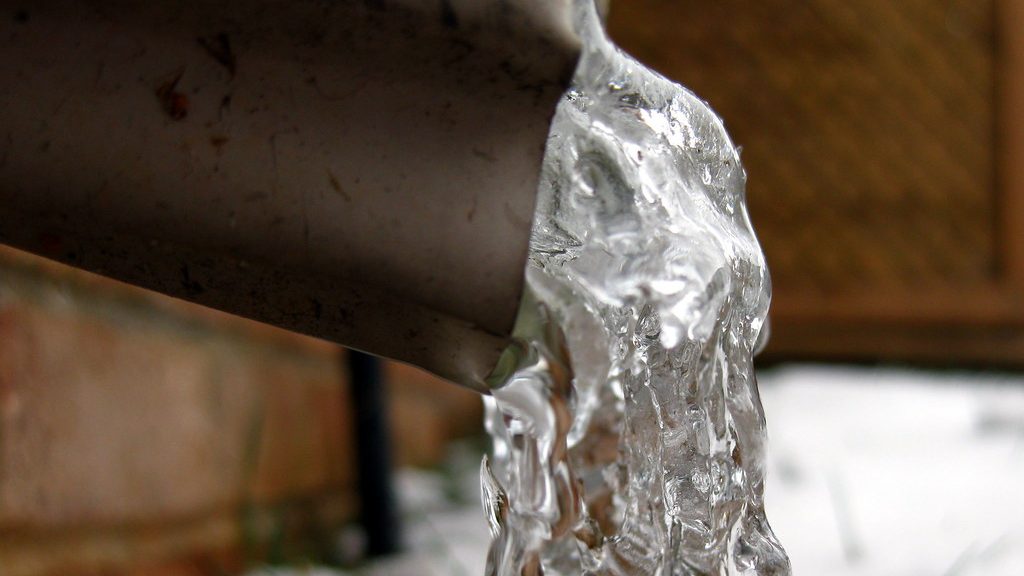
Photo: Skakerman (Archive) via Flickr (CC BY 2.0) · license
Water in a pipe freezes at 32°F, but pipes in unheated spaces are most at risk below about 20°F outside. Here’s what to do tonight, by forecast and symptom.
Both numbers are correct because they measure different things. The first is the temperature of the pipe. The second is the outdoor temperature at which pipes in the worst locations start losing that battle. The rest of this guide connects the two to your house and tonight’s weather.
Why 32°F and 20°F are both right
Water freezes when the pipe holding it reaches 32°F (0°C). Outdoor air has to pull the pipe down to that temperature, which takes time. Utah State University Extension notes that pipes freeze when they are exposed to freezing temperatures “for several hours.” That’s why a brief dip below freezing is less dangerous than a long, steady cold night.
The 20°F (-7°C) figure is an insurer’s risk line, not a freezing point. State Farm says pipes in uninsulated attics, crawl spaces, and exterior walls are most at risk, especially below 20°F. It is an alert line for unprotected pipes, not a rule for every pipe:
- Pipes inside heated, insulated rooms are not on State Farm’s at-risk list, as long as the heat stays on.
- Exposed lines such as outdoor hose bibs can freeze during any sustained stretch below 32°F.
- Everything else falls somewhere in between, depending on insulation and drafts.
Where you live matters too. The Insurance Institute for Business & Home Safety (IBHS) points out that plumbing in exterior walls is common in warmer Southern homes. Arctic outbreaks reach places where extreme cold is rare.
Wind chill doesn’t change the freezing point
A common worry is that a “feels like” temperature of 10°F can freeze pipes on a 30°F night. The National Weather Service says this is not how wind chill works. Wind chill applies only to people and animals. For objects such as water pipes and car radiators, wind only speeds up cooling toward the actual air temperature.
The Weather Service gives this example: at an air temperature of -5°F with a wind chill of -31°F, a car radiator will not drop below -5°F. The same holds for a pipe.
Plan around the forecast’s actual low and how many hours it will stay below freezing; treat wind as something that shortens the timeline, not something that lowers the danger temperature. A windy 25°F night is riskier than a calm one because pipes reach 25°F sooner. It still can’t make them colder than 25°F.
Find your exposed pipes first
According to the American Red Cross, the pipes that freeze most often fall into three groups:
- Pipes exposed to severe cold, such as outdoor hose bibs, pool supply lines, and sprinkler lines
- Supply pipes in unheated indoor areas, such as basements, crawl spaces, attics, garages, and kitchen cabinets
- Pipes along exterior walls with little or no insulation
If one room in your house always runs cold, check whether any plumbing passes through it. That room is likely your weak spot. The causes and fixes are covered in why one room in your house is always colder than the rest.
Tonight’s forecast × where your pipes run
Find the row for tonight’s forecast low, using the actual air temperature rather than wind chill. Then read across to each place your pipes run. Every action below comes from Red Cross, IBHS, State Farm, or Utah State Extension guidance; the risk levels are our own rough guide.
| Forecast low (actual air temp) | Inside heated, insulated space | Under a sink on an exterior wall | Garage, crawl space, or attic | Outdoor hose bib |
|---|---|---|---|---|
| 33–40°F | Minimal risk. No changes needed. | Low. No action needed unless the forecast is trending colder. | Low, but forecasts can miss. Use tonight to prepare. | Low tonight. Winterize now: close the inside valve and open the outside bib. |
| 21–32°F | Low. Keep the thermostat at the same setting day and night. | Moderate. Open the cabinet doors, move cleaners out of children’s reach, and drip cold water. | Elevated if the cold lasts for hours. Close the garage door and drip the faucets these lines feed. | High. Any sustained cold below 32°F can freeze it. Inside valve closed, outside bib open. |
| 20°F and below | Low while the heat stays on. Never set it below 55°F, even when away. | High. Open the cabinets, drip cold water, and keep the thermostat steady. | Highest. This is State Farm’s danger zone for uninsulated spaces. Take every step above, and remember that insulation alone won’t hold through a long freeze. | It should already be shut off and drained. If it isn’t, do that before dark. |
Wind can’t move you down a row, but it shortens the number of hours a pipe needs to reach that row’s temperature (National Weather Service).
Some notes on the actions in the table:
- Dripping. The Red Cross says to drip cold water from faucets served by exposed pipes, because even a trickle helps prevent freezing. The advice is aimed at faucets served by exposed pipes.
- Thermostat. This is not the night for a deep overnight setback. The Red Cross recommends keeping the same setting day and night during a cold snap.
- Hose bibs. The Red Cross says to close the indoor valve that feeds each outdoor faucet and leave the outside faucet open. That way, any water left in the line has room to expand without breaking the pipe. IBHS notes that homes built before 2010 typically don’t have frost-proof outdoor faucets, so in older homes, IBHS says to shut off and insulate those valves.
Symptom: one faucet trickles or gives nothing
The Red Cross says a faucet that produces only a trickle suggests a frozen pipe. Work through these four steps in order.
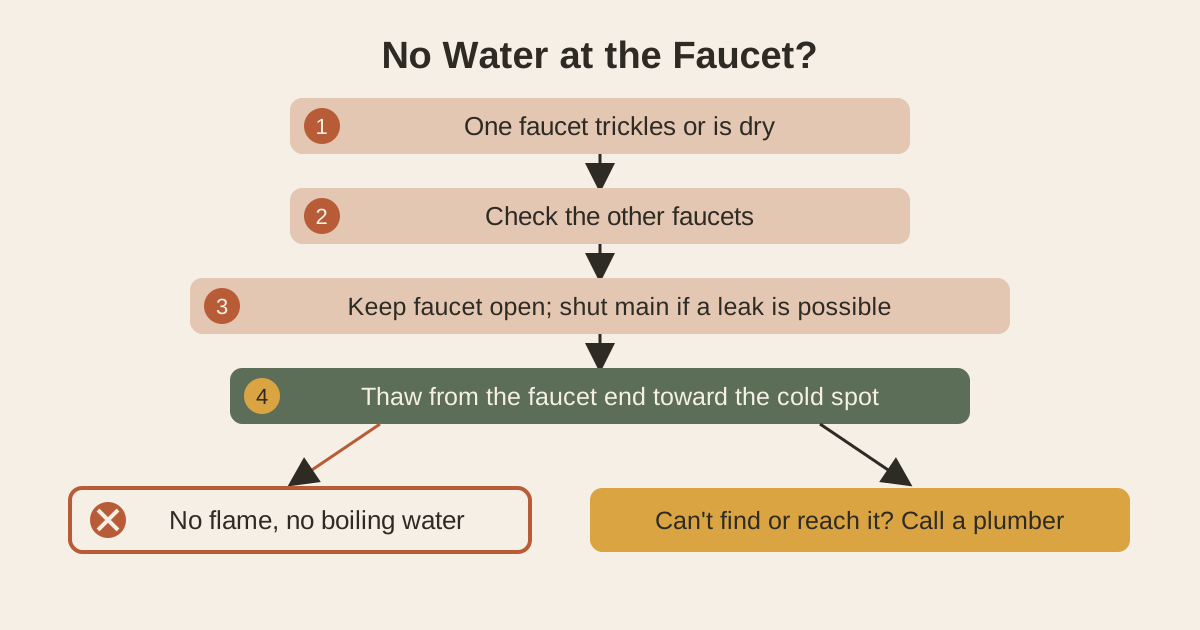
1. Check the other faucets
If one pipe has frozen, others may have too, so the Red Cross advises checking every faucet. If only one faucet is affected, the freeze is somewhere on that line. If every faucet is dry, the freeze may be where the water service enters the house, which the Red Cross lists as a common spot. It could also be a problem with the utility, and asking a neighbor whether they have water can rule that out.
2. Keep the faucet open, and decide about the main valve
Leave the faucet open so water can flow again once the ice clears. Utah State Extension recommends shutting off the main water supply before thawing, in case the pipe has already cracked.
Shutting the main first limits the damage if the pipe has already cracked. After thawing, turn it back on slowly and watch for leaks; the Red Cross’s sign of success is full water pressure returning. Keep buckets nearby, as USU advises.
3. Thaw from the faucet end, with safe heat only
Start warming the pipe at the faucet and work back toward the frozen section. Both Utah State Extension and State Farm recommend this order. Warm the pipe gradually, because USU warns that fast heating can make trapped water boil and can melt plastic faucet parts. The Red Cross says to keep heating until full water pressure returns.
Heat sources the Red Cross lists: - An electric heating pad - A hair dryer - Hot, wet towels - A space heater kept away from anything flammable
Never use: - A blowtorch or any other open flame - A kerosene or propane heater - A charcoal stove - Boiling water, which Utah State Extension specifically warns against
Two more cautions apply. First, keep hair dryers, space heaters, and other electrical appliances away from standing water, which both State Farm and USU flag as a shock risk. Second, if you use a space heater, Iowa State University Extension advises choosing one with tip-over and overheat shutoff, plugged directly into a wall outlet with no extension cord.
If the frozen pipe is a hot-water line or the main line, USU says it is often necessary to turn off the water heater.
4. Call a plumber if you can’t find or reach it
If the frozen section is inside a wall or ceiling, or you can’t locate it at all, the Red Cross says to call a licensed plumber. Guessing can mean cutting into drywall or overheating a hidden pipe. Use how to know if a repair is worth calling a pro for if you’re unsure where your limit is.
Symptom: water leaks or sprays as the pipe thaws
This means the pipe cracked while it was frozen. The Red Cross explains that water expands as it freezes, which puts tremendous pressure on the pipe. A crack may not leak until the ice melts and water can move again.
State Farm’s guidance is to shut off the main water valve and leave the faucets open. Keep electrical devices out of any standing water, then call a plumber to repair the cracked section.
Symptom: your water bill jumped, but you can’t see a leak
A crack from an earlier freeze can leak unseen inside a wall or crawl space. State Farm notes that even a small crack can release over 250 gallons a day. If your bill spiked and your household’s water use hasn’t changed, rule out a hidden leak before blaming the season. The full troubleshooting process is in why your water bill spikes in winter with no extra usage.
Symptom: the same pipe freezes every cold snap
A pipe that freezes winter after winter has a cause worth finding. These are the common fixes, along with their limits.
Insulate it properly, and know what insulation can’t do
Foam pipe sleeves help only when they are installed completely. Utah State Extension says insulation must:
- Cover the pipe, the fittings, and the fixtures
- Fit snugly and be taped in place
- Go on only after any leaks are fixed, so the insulation doesn’t get soaked
Insulation is not a permanent fix on its own. USU warns that it won’t protect pipes from prolonged freezing temperatures without some heat source, periodic water flow, or both. Insulate hot-water lines in cold spaces too. They freeze just like cold lines, and people rarely leave hot water dripping.
Seal the draft hitting the pipe
Check for outside air coming through a gap where the pipe passes through a rim joist, exterior wall, or foundation. Small gaps are a caulking job, covered in caulking 101. Larger openings may need foam instead.
Heat tape helps, but it is a fire risk if installed wrong
The Red Cross suggests UL-listed heat tape or heat cable for pipes in unheated areas. The Consumer Product Safety Commission has warned about these products. In an older release (No. 89-088), it cited about 3,300 residential fires a year involving heat tapes or cables. That figure is decades old, but CPSC’s installation rules are still worth following:
- Use tape sized to the pipe’s diameter and length.
- Wrap the tape directly on the pipe, never over insulation. CPSC warns that over-insulating can cause a fire.
- Don’t overlap the tape unless the manufacturer says it’s allowed.
- Inspect it every fall. Replace any tape with cracked covering, bare wires, or charring.
If a pipe still freezes after insulation, sealing, and properly installed heat tape, a plumber may need to reroute it into heated space.
Leaving home during a cold snap
An empty house has no one to notice a faucet that stopped dripping or a cabinet left closed. These steps come from IBHS, State Farm, and the Red Cross.
- Thermostat: set it to at least 55°F (13°C), even with no one home. IBHS, State Farm, and the Red Cross all give this same floor.
- Cabinets and hose bibs: open the sink cabinets on exterior walls, and close the indoor valves to outdoor faucets before you leave.
- Trips longer than a week in subfreezing weather: IBHS recommends closing the main valve slowly and letting a couple of faucets on the lowest floor drain the lines.
- Fire sprinklers: State Farm warns that shutting off the water also disables home fire sprinklers. If your home has them, weigh that tradeoff, or ask your plumber or sprinkler installer about your options before you leave.
- Renters: check with your landlord before shutting off or draining water. In many buildings the main valve serves more than one unit, and some leases require you to keep the heat at a set minimum.
Arranging for someone to check the house every few days also helps, because a failure caught early does far less damage.
Worked example: why the shutoff matters
Use State Farm’s small-crack figure and a typical holiday trip:
250 gallons per day × 4 days away = 1,000 gallons
That 1,000 gallons ends up in your walls, floors, or crawl space. It is also the small-crack case, since a larger split releases more water. To redo the math for your own trip, multiply the gallons per day by the number of days you’ll be gone.
The bigger cost is the damage the water causes. From 2024 through June 2025, State Farm paid more than 20,000 freeze-related claims totaling over $628 million, and the average payment was over $30,000. Shutting off the water before a long trip is free.
FAQ
Can PEX pipe still freeze?
Yes. Water freezes at the same temperature whether the pipe is copper, PVC, or PEX, and none of the guidance here makes an exception for plastic pipe. Protect PEX lines in cold spaces the same way you would metal ones. When thawing, use gentle, gradual heat, since USU warns that too much heat too fast can damage plastic parts.
Should I drip hot or cold water, and what will it cost?
The Red Cross recommends dripping cold water from faucets served by exposed pipes. Drip whenever those lines are exposed to below-freezing temperatures, which usually means overnight. If a hot-water line runs through the same cold wall, remember that USU notes hot lines freeze too.
To estimate the cost, catch the drip in a measuring cup for one minute. Convert that to gallons per hour, multiply by the hours you’ll drip, and multiply by your utility’s price per gallon. Compare that total with a small crack’s 250 gallons a day.
Should I put antifreeze in my sprinkler or pool lines?
Not unless the manufacturer or installer tells you to. The Red Cross specifically warns against adding antifreeze to these lines without that direction.
Sources
- Understanding Wind Chill (National Weather Service) — wind chill cools pipes faster but never below the air temperature, including the -5°F / -31°F example
- Preventing & Thawing Frozen Pipes (American Red Cross) — which pipes freeze most, dripping, cabinets, garage door, 55°F, hose bib winterizing, safe and unsafe heat sources, checking other faucets, UL-listed heat tape, antifreeze warning
- Advice to Prevent Frozen Pipes (Utah State University Extension) — “several hours” of exposure, limits of insulation, hot lines freezing, thaw-from-the-faucet procedure, no boiling water, water heater shutoff
- Check Heat Tapes, Cables For Possible Fire Hazards (CPSC) — dated fire statistic and heat-tape installation and inspection rules
- Frozen Pipes? Not So Nice! Beat Winter Water Woes Before They Strike! (State Farm Newsroom) — 20°F risk for uninsulated spaces, 250 gallons a day from a small crack, claim totals and average payment, burst-pipe steps, sprinkler shutoff warning
- IBHS Winter Weather Ready guide (IBHS) — Southern homes’ exterior-wall plumbing, pre-2010 outdoor faucets, 55°F minimum, procedure for absences longer than a week
Written and reviewed by peter.bae for Hearth & Habit · Last reviewed October 11, 2026


Comments
Post a Comment