Yellow-Brown Ceiling Stain With No Active Leak: What It Means
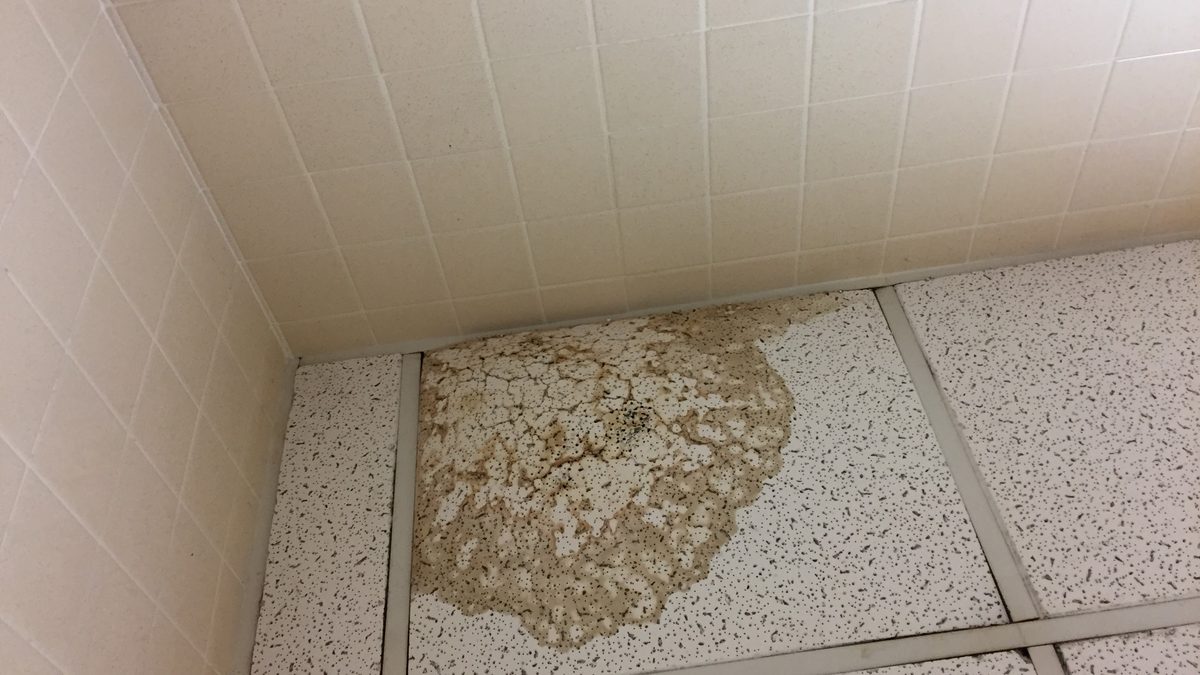
Photo: Atomicdragon136 via Wikimedia Commons (CC BY 3.0) · license
A yellow-brown ceiling stain with nothing dripping means water reached that spot at some point and left minerals behind as it dried. Before you prime it, prove it’s dry and match it to its trigger: rain, showers, winter thaws, or AC season.
The color tells you water passed through. It doesn’t tell you whether the water is done. The two checks below answer that, and the trigger table points you to the source and the fix that keeps the stain from coming back through new paint.
Step 1: Prove the spot is dry (and read the meter correctly)
Pressing on the stain catches the obvious cases. Soft, crumbly, or sagging drywall is wet or damaged, whatever the surface looks like. A firm stain can still hold moisture, though, so use a moisture meter.
Many meters read drywall on a relative scale, and that’s where people go wrong. Delmhorst, a moisture-meter maker, says the numbers on a reference scale “are not indicative of a specific percentage of moisture content.” A reading of 20 doesn’t mean 20% moisture, and there’s no single “dry” number to hit.
Use the method Delmhorst recommends instead: take a baseline on an unaffected, dry sample of the same material, then compare.
- Read a clean part of the same ceiling, well away from the stain.
- Read the center of the stain, then its edges.
- Compare. In Delmhorst’s example, a dry carpet sample reads 33 on a 0–100 scale and another piece of the same material reads 56. That higher reading means the second piece is at least slightly damp.
If the stain reads the same as your baseline, it’s dry today. Repeat the test after the next trigger event from the table below. A stain that’s dry in October can be wet again after the first snow thaw.
Can the drywall stay?
The US Environmental Protection Agency (EPA) gives a clear test for drywall after clean-water damage. It may be dried in place if there’s no obvious swelling and the seams are intact. If not, remove, discard, and replace it. Ceiling tiles (the lay-in panels of a drop ceiling) get discarded and replaced.
EPA’s 24–48 hour figure is easy to misread. It’s the window for drying clean-water damage before mold gets a start. It is not a waiting period before you can paint. A spot that’s been wet longer than that, or that got wet over and over, deserves a closer look for mold on the back side.
Step 2: Match the stain to its trigger
Leaks and condensation each have a schedule. Note when the stain appears or darkens, then use this table.
| When it appears or darkens | Likely source | What to check | The fix |
|---|---|---|---|
| After rain, especially wind-driven rain | Roof covering or flashing around a chimney, vent, or skylight | In the attic after rain, follow the damp trail on the sheathing uphill from the stain | Roof or flashing repair |
| After showers or baths, not rain, away from the bath fan grille | Tub or shower seal, or drain | Run the shower above for several minutes, then re-read the meter | Reseal or repair the drain |
| Around the bath fan grille, worse in cold weather | Condensation in the fan duct | Where the duct ends, whether it’s insulated, which way it slopes | Duct to outdoors, insulated, sloped away from the fan |
| Winter, with no rain; spots on a top-floor ceiling away from exterior walls | Attic condensation: humid indoor air condensing on cold attic surfaces | Attic on a cold morning: dampness or frost on the underside of the roof deck | Air-seal the ceiling, control indoor humidity |
| Snow season, near an exterior wall, with ice along the eaves above it | Ice dam backing water under the shingles | Ice ridge along the eaves | Attic air sealing, insulation, ventilation |
| Cooling season, under an attic air handler or AC unit | Clogged condensate drain overflowing the pan | Water standing in the pan under the unit | Clear the drain; add the overflow protection the code calls for |
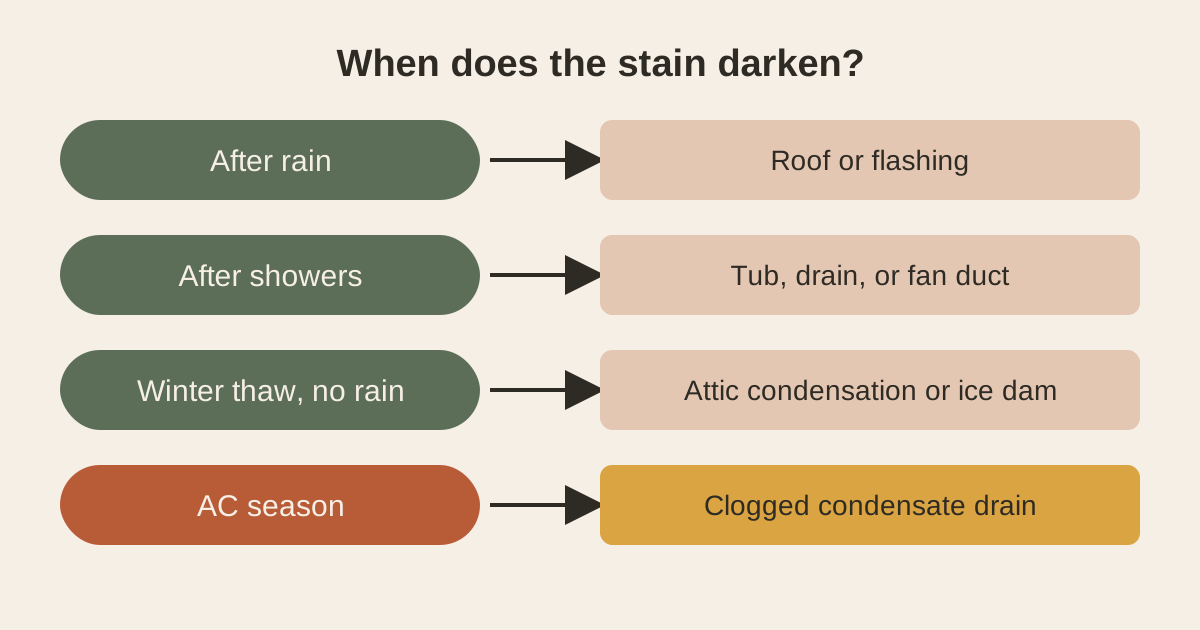
Water doesn’t always drop straight down. It can run along sheathing and framing first, so the entry point may be uphill or upstream of the stain. A stain on a first-floor ceiling with a full story above it points to plumbing before the roof. Roof water would have to travel through an entire floor to get there.
If it’s the bath fan duct
A bath fan stain that’s worse in winter may not be a leak. Warm, moist air cools inside a duct running through a cold attic, condenses, and runs back down to the fan.
The Building America Solution Center, a building-science guide run by Pacific Northwest National Laboratory (PNNL), sets out how the duct should be done:
- Vent directly outdoors. Never into the attic, a crawlspace, a garage, the space between floors, or a wall cavity.
- Insulate the duct to minimize condensation.
- Slope it down and away from the fan. For a side-wall vent, put the terminal slightly below the fan so condensation drains toward the outside, not back to the grille.
- Box the fan housing if it sits in the attic: an airtight rigid foam box, covered with attic insulation.
- Use smooth duct, and a damper at the exterior cap.
While you’re up there, check the fan’s rating. The same guide puts the minimum at 50 cfm (cubic feet per minute) for a fan that runs only when the bathroom is in use, or 20 cfm for one that runs continuously.
If it only happens in winter without rain
Stains on a top-floor ceiling that show up in winter without rain often come from attic condensation. Indoor air carries moisture from people, cooking, and bathing. When it leaks into a cold attic, it can condense on the cool surfaces, and that water can reach the ceiling.
Penn State’s Pennsylvania Housing Research Center says the fix starts at the ceiling, not the roof. Air sealing the top-story ceiling drywall at its seams and penetrations keeps warm, humid air from reaching the attic, where it would condense on cool surfaces in winter.
The researchers also note how vents can backfire. Concentrating openings high in the attic depressurizes it and pulls house air up through leaks in the ceiling. A more balanced distribution of vents slightly pressurizes the attic instead. So more vents high on the roof aren’t automatically the fix.
The EPA’s indoor humidity target is below 60%, ideally 30–50%. If your winter readings sit at the top of that range, lowering them cuts the moisture supply too.
A stain near an exterior wall during snow season is more likely an ice dam. The University of Minnesota Extension says ice dams come from heat escaping into the attic and melting roof snow, which refreezes at the colder eaves. The lasting fix is air sealing, insulation, and ventilation. Cleaning the gutters won’t do it.
If it only happens in AC season
An air conditioner’s indoor coil pulls water out of the air all cooling season. That water flows out through a drain line, and when the line clogs, the pan overflows onto the ceiling.
The International Residential Code (IRC), a model code many US jurisdictions adopt, covers this. It requires a backup wherever an overflow or clogged condensate line would damage the building, which typically includes a unit above a finished ceiling. The options are:
- an auxiliary pan under the unit whose drain discharges to a conspicuous point, a spot where occupants will notice it
- a separate overflow line from the unit’s own pan, also to a conspicuous point
- an auxiliary pan with a water-level switch (UL 508 listed) that shuts the equipment off before the pan overflows
- a water-level switch in the drain line or the unit’s own pan that shuts it off when the drain backs up
The code text calls for the auxiliary pan to be at least 1.5 inches deep and at least 3 inches larger than the unit in width and length. North Carolina’s State Fire Marshal reads the 3 inches as overall width and length, not 3 inches on every side. The pan has to sit where it will catch leakage from a blocked drain. For a horizontal furnace and coil bolted together, that means under both.
Two practical points follow. If the overflow pipe at that conspicuous point starts dripping, that’s the warning working. Call for drain service, and don’t cap it. And if you find standing water in the auxiliary pan, the primary drain is likely blocked or the unit is leaking, even if the ceiling looks fine so far. Your local code edition and inspector have the final word on which option your unit needs.
Before you cut, scrape, or dig in the attic
Two EPA cautions matter here.
- Textured ceilings. EPA lists textured paint and patching compounds used on walls and ceilings among the materials that may contain asbestos.
- Loose-fill attic insulation. Attic insulation containing vermiculite is on the same list.
You generally can’t tell by looking unless the material is labeled. EPA’s advice is to leave suspect material alone if it’s in good condition, and not to saw, sand, scrape, or drill it. Get a sample tested before you cut out a stained section of an older textured ceiling or dig through old attic insulation looking for a leak.
In the attic, step only on the framing, never between the joists. If water ever reached a ceiling light fixture, turn off that circuit and have the fixture checked before using it.
Fixing the stain once the source is fixed
- Confirm it’s dry with the baseline comparison above, after the source has been through at least one trigger event.
- Replace what can’t stay. Swollen drywall or opened seams get cut out and patched, per EPA’s test. The EPA says a homeowner can usually handle mold covering less than about 10 square feet (roughly 3 by 3 feet). Larger areas, or mold after sewage or contaminated water, call for a professional.
- Spot-prime with a stain-blocking primer. Ordinary ceiling paint alone won’t hide a water stain.
- Repaint. Flat ceiling paint helps the patch blend, and rolling the whole ceiling can avoid a halo.
If the stain is near a tub or shower you’ll be resealing, our caulking guide covers those joints. If you can’t find the source after a few trigger events, it’s a reasonable time to call a roofer, plumber, or HVAC tech. Our guide on when a repair is worth calling a pro for helps you decide which.
FAQ
The stain was there when I bought the house. How do I know if it’s old?
Run the baseline meter test now, then again after each trigger event in the table: a hard rain, a week of long showers, a winter thaw, a hot spell with the AC running. If the reading never rises above your baseline, the source is likely gone. If any single event pushes it up, you’ve found both the problem and its trigger.
Does a yellow stain mean there’s mold?
Not by itself. The stain shows that water passed through. Mold needs moisture that stays, so a musty smell, dark speckling, or soft drywall next to the stain is the signal to look closer. If the smell is spreading beyond the ceiling, our guide to finding a musty smell’s source room by room walks through it.
Can I just prime and paint and see if it comes back?
Only after the meter test says it’s dry. Priming over damp drywall can trap moisture, and any stain that keeps getting wet will show through again. That makes the repaint a costly way to run the test.
Sources
- Moisture Meter Reference Scale (Delmhorst) — relative-scale readings aren’t percent moisture; compare against a dry sample of the same material
- Mold Remediation Guide, Chapter 4 (US EPA) — 24–48 hour response window; when drywall can be dried in place; ceiling tiles discarded
- Bathroom Exhaust Fans (Building America Solution Center, PNNL) — vent outdoors, insulate and slope the duct, foam box, 50/20 cfm minimums
- Auxiliary and Secondary Drain Systems (UpCodes) and Auxiliary Drain Pan Size and Location (NC State Fire Marshal) — condensate overflow options, pan depth and size, pan placement
- Moisture Considerations for Roof/Attic Assemblies (Penn State PHRC) — ceiling air sealing against attic condensation; vent balance
- Learn About Asbestos and Protect Your Family from Asbestos (US EPA) — textured ceiling and vermiculite cautions; don’t saw, sand, or scrape
- Mold Cleanup in Your Home (US EPA) and A Brief Guide to Mold, Moisture, and Your Home (US EPA) — 10 sq ft DIY limit; humidity targets
- Dealing with and Preventing Ice Dams (University of Minnesota Extension) — ice dam cause and lasting fix
Written and reviewed by peter.bae for Hearth & Habit · Last reviewed October 11, 2026


Comments
Post a Comment