Gas Bill Higher This Winter Without Touching the Thermostat? Run This Checklist
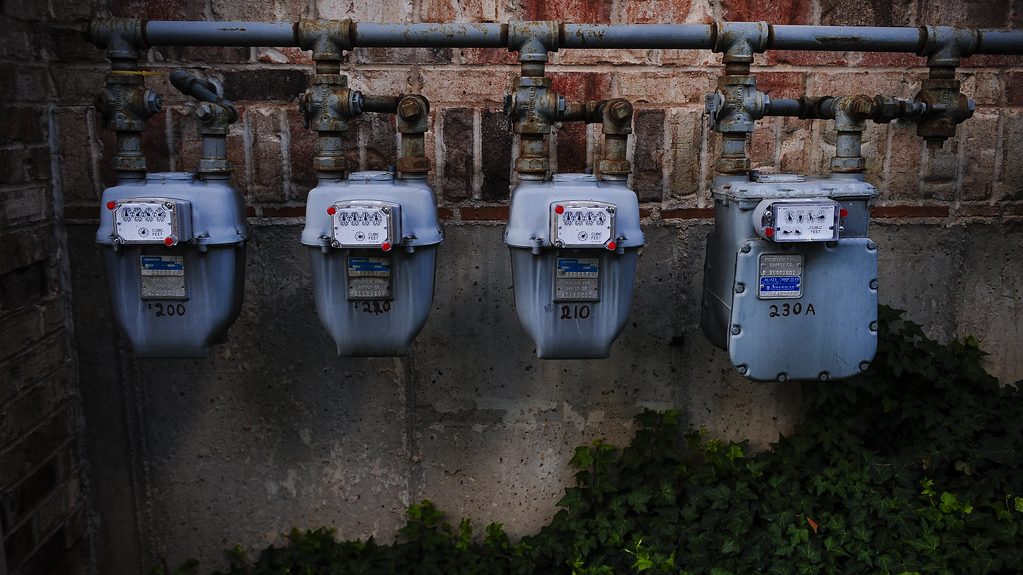
Photo: r.nial.bradshaw via Flickr (CC BY 2.0) · license
With the thermostat unchanged, a higher winter gas bill usually traces to colder weather, a higher price per therm, or a longer or estimated billing period. Only if those three don’t explain it is your house or furnace using more gas. Three numbers from your bills, compared with the same month last year, tell you which.
The thermostat setting is only half the story. Your furnace has to replace whatever heat the house loses, and it loses more on colder days. “I didn’t change anything” is consistent with a much bigger bill.
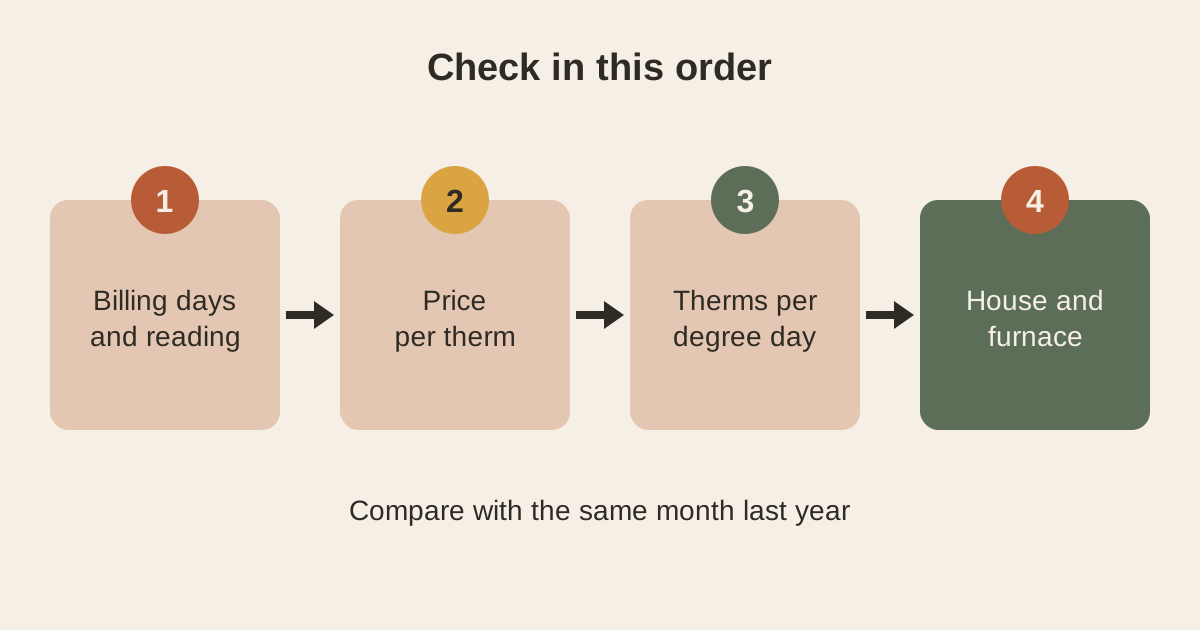
Step 1: Check the billing period and the reading
Find the billing days and the reading type on both bills.
- Billing days. A 33-day bill and a 29-day bill aren’t comparable. Divide therms by days before comparing anything.
- Estimated reads. Manitoba Hydro explains that estimated readings are based on last year’s use. If last winter was milder, this winter’s estimates run low, and the next actual reading charges for the difference. That one bill looks like a spike, but it’s really the earlier estimated months catching up. Add the estimated bills and the catch-up bill together and compare the total with the same stretch last year.
Step 2: Check the price per therm
Divide the total bill by the therms used. That gives an all-in price including delivery charges and fees. Do the same for last year’s bill.
If your bill shows CCF instead of therms: a CCF is 100 cubic feet of gas. EIA lists 1,036 Btu per cubic foot and 100,000 Btu per therm, so 1 CCF is about 1.036 therms. Your utility may use its own conversion factor printed on the bill. Either way, compare like with like.
Gas prices move for reasons outside your house:
- Cold weather pushes up the price itself. EIA explains that heating demand rises in cold months, and when cold comes unexpectedly, “the effect on prices can intensify because supply is often unable to react quickly.” A cold winter can raise both how much gas you use and what you pay for it.
- Rates change during the season. Manitoba Hydro, for one, reviews its natural gas rates quarterly: in February, May, August, and November. Your January and March bills could be on different rates.
- Compare winter with winter. EIA’s figures put the US residential average at $14.95 per thousand cubic feet in February 2026. With EIA’s conversion factors that’s about $1.44 per therm (1,000 × 1,036 = 1,036,000 Btu, or 10.36 therms, and $14.95 ÷ 10.36 = $1.44). The same table shows $24.09 in June and $26.45 in July. Monthly averages swing widely, so a summer bill says little about winter pricing.
If your price per therm rose and your therms per day didn’t, the cause is the price, not the house. Ask the utility which part rose: the supply rate, delivery, or a fixed charge.
Step 3: Adjust for the weather with degree days
This is the step that tells you whether your house is actually performing worse.
How degree days work
The US Energy Information Administration uses heating degree days (HDD) to measure how much heating a building needs. For each day, average the high and low. If that average is below 65°F, subtract it from 65. A day with a high of 33°F and a low of 25°F averages 29°F, so it counts as 65 − 29 = 36 HDD. Add the daily figures for the billing period. You can work them out from the daily highs and lows for your area.
Subtract the gas you’d use anyway
About 60% of US homes use natural gas, EIA says, for space heating, water heating, cooking, and clothes drying. The heating part is what tracks the weather most. Your summer bill shows roughly what the rest uses, since the furnace is off. Subtract that baseline before dividing.
Worked example
These numbers are hypothetical; swap in your own.
- Summer baseline: a July bill shows 18 therms over 30 days, or 0.6 therms a day. A 31-day January then has about 0.6 × 31 = 18.6 therms of non-heating use.
- Last January: 136 therms and 1,000 HDD. Heating gas = 136 − 18.6 = 117.4 therms. Per degree day: 117.4 ÷ 1,000 = 0.117.
- This January: 160 therms and 1,200 HDD. Heating gas = 160 − 18.6 = 141.4 therms. Per degree day: 141.4 ÷ 1,200 = 0.118.
Total gas use went up 24 therms, about 18%. Gas per degree day barely moved. This house is performing the same as last year, and the weather explains the increase.
Now suppose this January showed 175 therms against the same 1,200 HDD: (175 − 18.6) ÷ 1,200 = 0.130. That’s about 11% more gas per degree day of cold than last January (0.130 ÷ 0.117 = 1.11). That’s the signal that something in the house or the heating system changed, and the time to work through Step 4.
Step 4: If gas per degree day went up, find the cause
Start with the cheapest checks.
| Check | What the sources say | Next step |
|---|---|---|
| Furnace filter | ENERGY STAR says to check it every month in heavy-use months and change it at least every 3 months | Swap it; our furnace filter guide covers sizing and MERV |
| Thermostat schedule | General check, not from a source: a “hold” or a changed schedule can run the house warmer than the display suggests | Scroll the full schedule, not just the current reading |
| Drafts at doors and windows | ENERGY STAR calls door weatherstripping and window caulking the simpler sealing jobs; sealing and insulating can save up to 10% on annual energy bills | Seal the obvious gaps; see where to caulk |
| Ducts | ENERGY STAR says sealing ducts can improve system efficiency by as much as 20% | Look for disconnected or leaky ducts in unheated spaces, or have them tested |
| Icicles and ice dams | University of Minnesota Extension says these come from heat escaping into the attic, not from the gutters | Attic air sealing, insulation, and ventilation |
| One room never warms | General check, not from a source: a lagging room tempts people to turn the thermostat up | See why one room stays colder |
| Water heater | Its gas use is part of the baseline; if the summer baseline itself rose, look here | If it rumbles or pops, see the water heater noise guide |
| Furnace condition | Manitoba Hydro lists furnace condition among the reasons bills rise; ENERGY STAR says a yearly tune-up can improve efficiency | Book a tune-up |
Turning the thermostat up isn’t the fix for a lagging room. Manitoba Hydro notes that turning the thermostat up “doesn’t heat the home faster but increases the bill.”
The DOE’s setback figure works in reverse, too. A 7–10°F setback for 8 hours a day can save up to about 10% a year on heating and cooling. A schedule that has quietly stopped setting back gives up that savings.
Step 5: If nothing explains it, question the meter
If billing days, price, degree days, and the house all check out, ask the utility to verify the meter. The rules vary by state, and Maryland’s Public Service Commission is a clear example:
- The utility must test your gas or electric meter on request at no charge, though not more often than once in 18 months.
- You can request a commission “referee test” for $10. It’s refunded if the meter turns out to be inaccurate.
- An estimated bill must be marked as estimated. If one is far out of line, you can ask the utility to cancel it, but the next bill will then cover two months.
Search your own state commission’s site for “billing dispute” to find your local rule.
Safety: when a high bill isn’t the main problem
A rising gas bill alongside a gas smell, soot around the furnace, or a CO alarm going off is a safety issue first. Leave the house and call your gas utility from outside if you smell gas. If the CO alarm sounds, get everyone outside too and call your gas utility or emergency services from there. Have a technician inspect the furnace before you use it again, or if you see soot. Test CO alarms monthly so they work when it counts.
FAQ
Why is my December bill so much higher than November’s at the same setting?
Comparing month to month mostly measures the weather. A colder month has more heating degree days, so it needs more gas at the same setting. Compare December with last December, per degree day, using the method above.
My bill says CCF, my neighbor’s says therms. Who pays more?
You can’t tell until you convert. With EIA’s factors, 1 CCF is about 1.036 therms. Convert both bills to price per therm before comparing.
Could the furnace be failing even if it still heats the house?
It can. A rise in gas per degree day is one sign that the house or the furnace is using more gas than before. A tune-up is the next step. A cracked heat exchanger or burner problem is a job for a technician, not a DIY diagnosis.
Sources
- Degree days | U.S. EIA and British thermal units | U.S. EIA — HDD method and example; Btu per therm and per cubic foot
- Natural Gas Prices | U.S. EIA and Factors affecting natural gas prices | U.S. EIA — 2026 monthly residential prices; cold-weather price effects
- Use of natural gas | U.S. EIA — about 60% of homes use gas for heating, water heating, cooking, and drying
- Reasons for a high bill | Manitoba Hydro — estimated readings and catch-up bills, quarterly gas rate reviews, furnace condition
- Billing Disputes FAQ | Maryland Public Service Commission — free meter tests, referee test, estimated bills
- Heat & Cool Efficiently | ENERGY STAR and Seal and Insulate | ENERGY STAR — filter checks, tune-ups, duct sealing up to 20%, sealing and insulating up to 10%
- Dealing with Ice Dams | University of Minnesota Extension — ice dams come from attic heat loss
- Programmable Thermostats | DOE Energy Saver — 7–10°F setback for 8 hours saves up to about 10% a year
Written and reviewed by peter.bae for Hearth & Habit · Last reviewed October 11, 2026


Comments
Post a Comment