Should You Shut Off the Outdoor Faucet From Inside Before Winter, and Where Is the Valve?
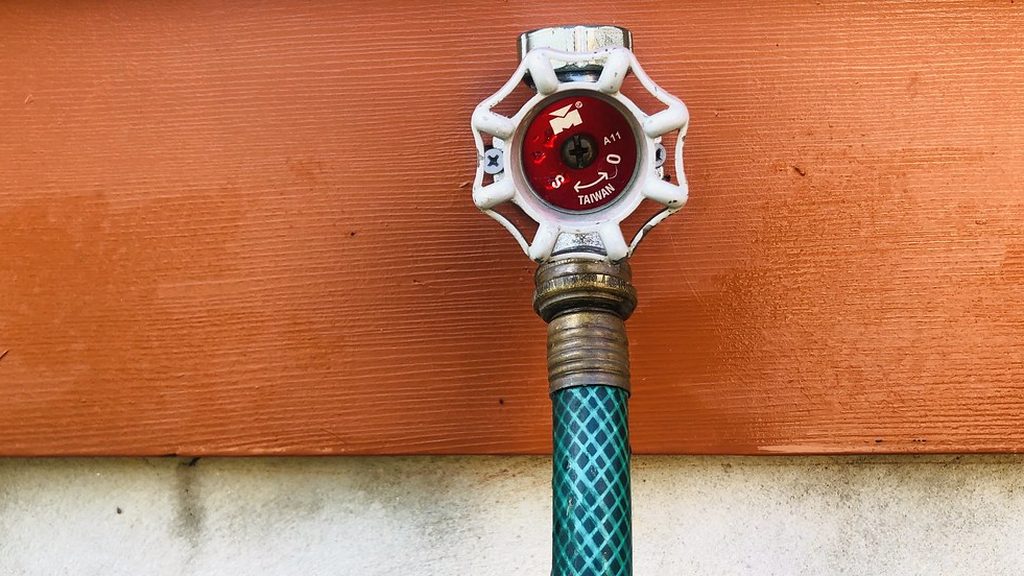
Photo: helpatmyhome via Flickr (CC BY 2.0) · license
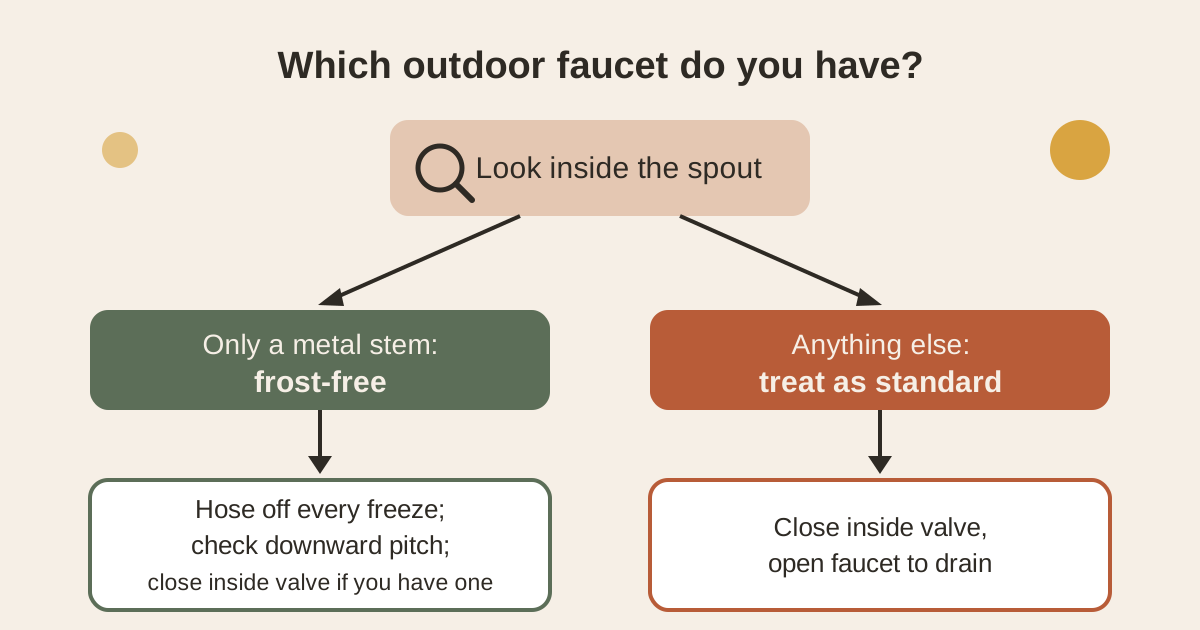
If your outdoor faucet is the standard kind, yes: close its inside valve, then open the outdoor faucet so the line drains. If it’s a properly installed frost-free faucet, removing the hose matters most, but closing an inside valve if you have one costs nothing.
The catch is knowing which kind you have, and the quick handle check that gets passed around isn’t reliable. Here’s how to tell, where the valve usually is, and what each type needs before the first hard freeze.
The two kinds of outdoor faucet, and why it matters
A standard outdoor faucet has no long stem: it shuts off at the outside wall, so the pipe leading to it stays full of water. That’s the pipe you shut off and drain from inside.
A frost-free faucet (also called a frost-proof sillcock or freezeless wall faucet) has a long stem. Home inspector Reuben Saltzman of Structure Tech describes it as turning the water off well inside the wall. Installed with a slight downward pitch, the water left in the stem drains out when you shut it off.
That only works if a few conditions hold, and they’re where most frost-free failures start.
How to tell which one you have
The usual advice is to look at the handle: if the knob points straight out from the house, it’s frost-free. Saltzman calls that a rule of thumb and points out where it fails. A boiler drain mounted outside has the same straight-out knob and isn’t frost-free. And Woodford’s model 101 isn’t frost-free, yet he says you can’t tell it from the frost-free models except by the model number.
The better check is to look up inside the spout with a flashlight. On a frost-free faucet, Saltzman says, all you’ll see is a metal stem. If you see anything else, our advice is to treat it as a standard faucet.
Age is a clue too. The Insurance Institute for Business & Home Safety (IBHS) says homes built before 2010 typically don’t have frost-proof outdoor faucets.
What each faucet needs before the first freeze
This table pulls together the model plumbing code, Woodford’s product spec, Structure Tech’s inspection guidance, and a Contractor Magazine analysis of freeze failures.
| Your faucet | Garden hose | Inside valve | Outdoor faucet |
|---|---|---|---|
| Standard, with an inside valve | Off and drained | Close it, then open the bleeder cap if it has one | Leave it open |
| Standard, no inside valve you can find | Off and drained | Ask a plumber about adding one | Main shutoff is the fallback |
| Frost-free, stem ends in heated space | Off, every time it freezes | Close it if you have one; Saltzman still recommends having one | Closed |
| Frost-free, stem ends in a crawl space | Off | Close it and drain if you have one | Leave it open |
A few rows need explaining.
Bleeder cap and open faucet. Saltzman’s sequence for a valve that has a small bleeder cap: close the valve, unscrew the cap, and let the line drain. He notes the water may come out of the cap or out of the outdoor faucet, depending on how the pipe is pitched, so keep a small bucket handy. Screw the cap back on and leave the outdoor faucet open for the winter.
The crawl-space row. The model plumbing code for houses, the International Residential Code (IRC), covers outdoor faucets in section P2903.10. It requires hose bibbs subject to freezing, “including the frostproof type,” to have an accessible stop-and-waste valve inside the building so they can be shut off and drained during cold periods. The exception is a frost-free faucet whose stem extends through the building insulation into open heated or semiconditioned space.
A North Carolina fire marshal’s office interpretation of that code says stems ending in a ventilated crawl space may use the exception, because those spaces usually hold enough ground heat, but calls it not a blanket exemption: the permit holder has to judge local conditions. It also warns that in older houses with little floor insulation, relying on leaked heat to protect the faucet may not be practical. If your stem ends in a crawl space like that, our advice is to close and drain an inside valve if you have one. Local codes adopt and amend the model code differently, so a local plumber or inspector has the final word.
Why frost-free faucets still burst
Contractor Magazine’s look at frost-free freeze failures puts the attached hose first: “It’s the hose nobody disconnected in November.” A hose left on over winter blocks drainage, and water trapped in the barrel freezes and cracks the housing. Woodford’s spec for the Model 17 is blunt: the hose must be removed in freezing weather or the faucet may freeze and burst.
Two other causes are installation problems:
- Pitch. The faucet should tilt slightly downward toward the outside. Saltzman says that without the pitch, water sits inside the stem even when it’s turned off. Contractor Magazine adds that if it’s dead level, or pitched back toward the house, water won’t fully drain. Saltzman’s fix is to have it reinstalled with a slight downward pitch.
- Stem length. In Contractor Magazine’s words, “incorrect stem length places the shutoff in the cold zone.” It notes that a unit sized for a 2x4 wall won’t work in a 2x6 wall or one with brick veneer added. You can’t see stem length from outside, so ask whoever installs or services the faucet.
Worked example: picking a stem length
Woodford sells the Model 17 in wall-thickness sizes from 4 to 24 inches in 2-inch steps, and gives the overall length as wall thickness + inlet length. Contractor Magazine’s advice is to measure the actual wall assembly, including insulation and siding, rather than assuming a standard wall.
Measured wall: 9 inches. Nearest Model 17 sizes: 8 or 10 inches. Our reading: choose 10, since the shutoff needs to sit past the cold part of the wall, and an 8-inch unit is sized for a thinner wall than you have.
That rounding-up rule is our inference from the sizing, not a line in Woodford’s spec. Other brands have their own charts, so check the one for the faucet you buy, or ask the plumber installing it.
One more line from Woodford’s spec is worth knowing: the Model 17 shall not be subjected to more than 12 hours of continuous water pressure.
Where the inside valve usually is
Saltzman says exterior faucets should have a separate shutoff inside, but not all of them do. In older homes, he says, the valve is typically at the ceiling close to the outside faucet. To look for it there:
- Go to the room or space directly behind the outdoor faucet.
- Follow the pipe from where it leaves the wall back toward the house’s supply lines.
- Look for a valve near the ceiling. If it has a small cap, that cap is the bleeder.
If you can’t find one, the main shutoff is the sure way to cut that faucet’s water. Adding a valve means cutting into a supply line, which is a plumber’s job; whether that’s worth a call is covered in how to know if a repair is worth calling a pro for. In the meantime, know where your home’s main shutoff valve is and how to operate it, as IBHS advises.
The spring surprise, and what it costs
A frost-free faucet that froze often isn’t discovered until spring. Saltzman explains that the first time someone turns it on, “water starts shooting out of the burst stem inside the house.”
Turn the faucet on for the first time in spring while someone watches the inside of that wall. If anything appears, shut the inside valve or the main.
A cracked pipe left running adds up fast. State Farm says a small crack can release over 250 gallons of water a day:
If a crack goes unnoticed for 3 days: 250 gallons per day × 3 days = at least 750 gallons
State Farm’s average freeze-claim payment exceeded $30,000 from 2024 through June 2025.
The hoses themselves
University of Georgia Extension gives two options: leave hoses hanging outside disconnected from the faucet, or disconnect, drain, and store them somewhere that stays at a constant temperature. If you leave them outside undrained, don’t move them in freezing weather, because frozen hoses are fragile.
The faucet is one item on the list. The rest of the outdoor jobs worth doing before winter are in the fall yard cleanup checklist. For the pipes inside the house, see at what temperature pipes start to freeze.
Sources
- Code interpretation: P2903.10 Hose bibb freeze protection (NC Office of State Fire Marshal) — IRC P2903.10 text and exception, crawl-space interpretation, caution about relying on leaked heat
- Woodford Model 17 Freezeless Anti-Siphon Wall Faucet (product specifications) — hose removal and pitch requirements, wall-thickness sizes and length formula, 12-hour pressure limit
- How to winterize your outside faucets (Structure Tech Home Inspections) — how frost-free faucets work, pitch, valve location in older homes, bleeder-cap draining, spring discovery of burst stems
- How to prevent outside faucets from freezing, with author replies (Structure Tech) — why the handle test fails, the look-inside-the-spout check, and keeping a separate inside valve
- The Frost-Free Bibb Isn’t the Problem (Contractor Magazine) — attached hoses, pitch, and short stems as failure causes
- Winterizing Outdoor Pipes and Sprinklers (UGA Cooperative Extension) — hose storage over winter
- IBHS Winter Weather Ready guide (IBHS) — pre-2010 homes and frost-proof faucets, knowing the main shutoff
- Frozen Pipes? Not So Nice! (State Farm Newsroom) — 250 gallons a day from a small crack, average freeze-claim payment
Written and reviewed by peter.bae for Hearth & Habit


Comments
Post a Comment