Why Does My Brown Sugar Turn Rock-Hard, and Can You Still Use It?

Brown sugar turns hard because the moisture in its molasses evaporates, and sugar that has simply dried out is still usable. Heat softens it only until it cools; putting moisture back is the fix that Domino says should leave it soft.
Domino, the sugar maker, says brown sugar’s shelf life is indefinite, and that sugar stored in a container in a cool, dry place doesn’t support microbial growth. That makes a dried-out lump a texture problem. Sugar that got wet, shows mold, or has insects in it is a different problem, and it goes in the trash. For ordinary hardness, the trick is matching the fix to your deadline. Some fixes give you a usable cup in a few minutes that hardens again as it cools. Others take a day or two but leave the whole container soft. Below, each situation gets its own fix, followed by a water-dose table you can scale to any amount.
What’s actually happening in the bag
King Arthur Baking explains that molasses supplies the moisture that keeps brown sugar soft, and that when the sugar is exposed to air too long, that moisture evaporates. Domino says the same thing, that brown sugar becomes hard when the moisture in it evaporates. It adds the point that matters for fixing it: the softening methods are all meant to return moisture to the sugar.
Even good storage only slows this down. Ohio State University Extension says that while airtight containers are suitable for brown sugar, it will likely still harden after a few months. A hard bag doesn’t mean you did something wrong.
If you’re wondering whether it’s still good
Drying out alone doesn’t make it unsafe. Domino’s FAQ says sugar kept in a container in a cool, dry location has an indefinite shelf life because it doesn’t support microbial growth. It also says that even though brown sugar’s shelf life is indefinite, it’s best used within six months of purchase for maximum flavor.
The university numbers you’ll see don’t agree exactly, and two of them are labeled as freshness or flavor windows:
| Source | How long brown sugar keeps | How the source labels it |
|---|---|---|
| Ohio State Extension | 4 months | Pantry chart value, in an airtight container |
| University of Georgia | 4 to 6 months | “Maximum freshness” |
| Washington State University Extension | 4 to 6 months | “Maximum flavor” |
| Domino | Best within 6 months; shelf life indefinite | “Maximum flavor” |
Domino puts “indefinite” right next to its own six-month flavor window. That’s the way to read the UGA, WSU, and Domino dates: they tell you when the sugar is at its best. All of this applies to sugar that dried out. None of these sources says moldy or bug-infested sugar is usable, so don’t stretch it that far.
If you need it in the next few minutes
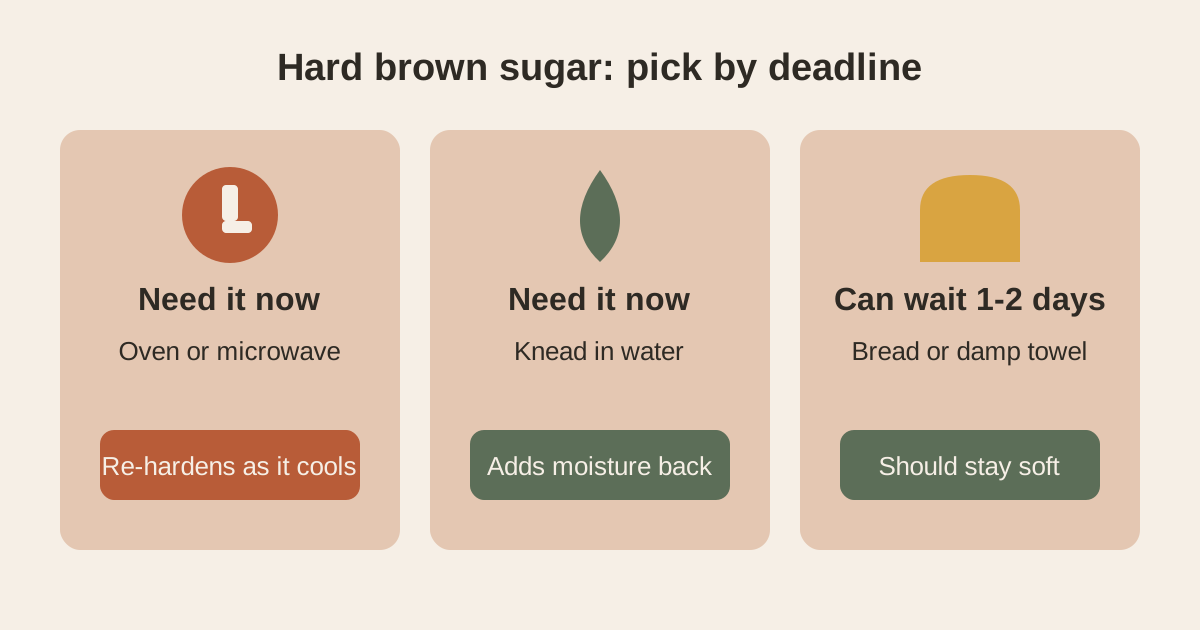
You have two heat options. Both are temporary.
- Oven: Domino and the University of Georgia both use 250°F, and the University of Georgia says a few minutes is enough. Domino says to put the sugar in an oven-safe container and measure what you need as soon as it’s soft, because it will harden again as it cools. Domino also warns that oven-heated sugar is very hot, so handle the container with oven mitts and scoop with a spoon or measuring cup.
- Microwave: Every source uses a microwave-safe bowl or container and some moisture, but the times range from 10 seconds to 2 minutes, and the setups differ too. Only Domino gives an amount:
| Source | Amount | Moisture and cover | Time |
|---|---|---|---|
| Ohio State Extension | Not specified | Slice of bread in the bowl, plastic wrap over it | 10 to 20 seconds on high |
| Washington State University Extension | Not specified | Clean, white, wet paper towel | 30 seconds |
| University of Georgia | Not specified | White damp paper towel laid loosely on top | On high, check every 30 seconds |
| Domino | About ½ lb | Two wet (not dripping) paper towels, bowl tightly sealed with plastic wrap | 1½ to 2 minutes on high |
Because the sources don’t agree, the University of Georgia’s approach is a practical way to use them: heat in short rounds and check every 30 seconds instead of committing to one long run. Domino’s 1½ to 2 minutes is for its sealed half-pound bowl, and Domino notes that microwaves vary in power.
Ohio State and Domino both say microwave-softened sugar hardens again once it cools. So microwave only what the recipe needs, measure it while it’s warm, and put the rest back in the bag as is.
If you need it now without heating it
Of the sources here, only King Arthur gives this fix. King Arthur, citing Stella Parks, adds 3/4 teaspoon (3.5 grams) of water per 8 ounces of brown sugar to a bag and kneads it until the sugar is uniform and soft. It puts the evaporated water straight back instead of borrowing it from bread or a towel, so you aren’t waiting a day on a slow transfer. It works the way Domino says softening methods are meant to, by returning moisture, rather than by warming the sugar the way the oven and microwave do. None of the sources says how long kneaded sugar stays soft, so seal the bag tightly afterward.
The source gives the dose per 8 ounces. To scale it, the inputs are King Arthur’s dose and King Arthur’s weight chart, which puts a packed cup of light or dark brown sugar at 7½ ounces (213 grams):
| Amount of hard brown sugar | Weight | Arithmetic | Water to knead in |
|---|---|---|---|
| 1 packed cup | 7½ oz (213 g) | 7.5 ÷ 8 = 0.94; 0.94 × 3.5 g | about 3.3 g, just under ¾ tsp |
| Half a pound | 8 oz | the base dose | 3.5 g, ¾ tsp |
| 1 lb | 16 oz | 16 ÷ 8 = 2; 2 × 3.5 g | 7 g, 1½ tsp |
| 2 lb | 32 oz | 32 ÷ 8 = 4; 4 × 3.5 g | 14 g, 3 tsp (1 tbsp) |
For a cup, a level ¾ teaspoon is close enough. The ¾-teaspoon-per-half-pound ratio is the part to keep, so measure the water instead of pouring a splash.
If you can wait a day or two
These methods move moisture slowly into the whole container.
- Bread: King Arthur seals a slice of soft sandwich bread in with the sugar for 24 hours, or at least overnight, then throws the bread away. It says sliced apple works too.
- Damp paper towel: Domino lays a small piece of plastic wrap or foil on the sugar, puts two damp (not dripping) paper towels on top of that, and seals the container.
- Terra cotta disk or marshmallows: Domino’s storage page also lists a damp terra cotta disk, or one or two large marshmallows, as moisture sources.
Domino says to remove the bread or towel once the sugar absorbs the moisture and softens, which takes about two days. Then reseal the container tightly. After that, Domino says, the sugar should remain soft. A slice of bread left in a warm pantry has its own problems, covered in why bread goes moldy faster in summer, so take it out on time.
If it keeps happening
Every source here agrees the container has to be tightly closed. Domino’s brown-sugar answer adds a surprising detail: store it in a cool, moist area, even though its shelf-life answer for sugar in general mentions a cool, dry location. Keep it in a covered container, or empty it into a rustproof container or a heavy moisture-proof plastic bag and keep that tightly closed. The point is to keep the sugar’s own moisture in. King Arthur adds that you should press as much air as possible out of the bag. The University of Georgia says the original plastic bag works if it’s tightly closed.
Two things that seem helpful aren’t:
- The refrigerator. Domino says plainly not to store brown sugar there.
- Assuming airtight means permanent. Ohio State’s point stands: brown sugar in an airtight container will likely still harden after a few months. King Arthur suggests keeping a soaked and blotted terra cotta disk (sold as a Brown Sugar Saver) in the container, where it slowly releases moisture back into the sugar.
If you live somewhere very dry or will keep the sugar a long time, Domino suggests the freezer. Thaw it for two to three hours before using. If ice crystals formed during long storage, stir the sugar gently as soon as it thaws so pockets of moisture don’t cause damage.
Not every pantry staple wants a sealed container, though. Onions and garlic need the opposite, as why onion and garlic storage keeps sprouting indoors explains.
If it’s white sugar or powdered sugar that went lumpy
Don’t use the brown sugar fixes here.
- White granulated sugar has the reverse cause. Domino says it hardens when it’s exposed to moisture. Domino’s fix is to warm the oven to 150–200°F, turn it off, and leave the sugar in an oven-safe container for about 15 minutes, then tap it with a spoon. If it doesn’t break apart, leave it in the oven for an hour to dry out. The University of Georgia puts it in a sturdy food-quality bag and pounds it with a hammer, and WSU says a meat mallet or hammer works. The moisture fixes above work in the wrong direction for it.
- Powdered sugar lumps can’t be adequately restored, Domino says, because of the cornstarch in it.
Ohio State’s chart lists granulated sugar at 2 years, confectioners’ sugar at 18 months, and brown sugar at 4 months.
Sources
- FAQ Page (Domino Sugar) — why brown sugar hardens, indefinite shelf life and the six-month flavor window, the 250°F oven and ½-lb microwave methods, the two-day towel method, no refrigerator, freezing and thawing, white and powdered sugar lumps
- How to Store Domino Brown Sugar (Domino Sugar) — terra cotta disk and marshmallow options, the turned-off 150–200°F oven for hardened white sugar
- Pantry Food Storage, HYG-5401 (Ohio State University Extension) — hardening even in airtight containers, the 10-to-20-second microwave method with bread, the 4-month, 18-month, and 2-year chart values
- Check your cooking staples (University of Georgia) — 4 to 6 months of maximum freshness, the 250°F oven, 30-second microwave checks, pounding hardened white sugar
- Cleaning Out the Kitchen Cupboard (Washington State University Extension) — 4 to 6 months for maximum flavor, the 30-second microwave method, a mallet or hammer for lumpy white sugar
- How to soften brown sugar (King Arthur Baking) — molasses moisture evaporating, overnight bread or apple, the 3.5 g of water per 8 oz kneading method, the terra cotta disk, pressing out air
- Ingredient Weight Chart (King Arthur Baking) — a packed cup of brown sugar weighs 7½ oz (213 g)
Written and reviewed by peter.bae for Hearth & Habit


Comments
Post a Comment