Why Did My Electric Bill Double With No Change in How I Use Power?

When a bill doubles and your habits didn’t change, the cause is usually the price (an expired fixed-rate plan, a rate tier, a budget-billing settle-up), the billing (extra days or an estimated read catching up), or weather and backup heat. Three numbers on the bill tell you which.
Most advice stops at “compare your kWh to last year.” That’s a good start, but kWh alone can mislead you. A bill that covers more days has more kWh even if your daily use hasn’t changed, and a higher price can double the total while your kWh stays flat. Splitting the bill into three parts shows which one moved.
Break the bill into three numbers
Every electric bill shows three things: the days in the billing period, the kWh used, and the total. From those you can work out two more:
- kWh per day = kWh used ÷ days billed
- Average price = total charges ÷ kWh used
Do this for the new bill and for the same month last year. Comparing to the same month matters because it’s the same season, so weather is less likely to be the difference.
Worked example
These are hypothetical numbers. Last year’s bill uses the US average price of about 17¢ per kWh from the U.S. Energy Information Administration (EIA).
| Last year, same month | This bill | Ratio | |
|---|---|---|---|
| Days billed | 30 | 33 | 33 ÷ 30 = 1.10 |
| kWh used | 900 | 1,188 | |
| kWh per day | 900 ÷ 30 = 30 | 1,188 ÷ 33 = 36 | 36 ÷ 30 = 1.20 |
| Total | 900 × $0.17 = $153 | $297 | |
| Average price | $153 ÷ 900 = 17¢ | $297 ÷ 1,188 = 25¢ | 25 ÷ 17 = 1.47 |
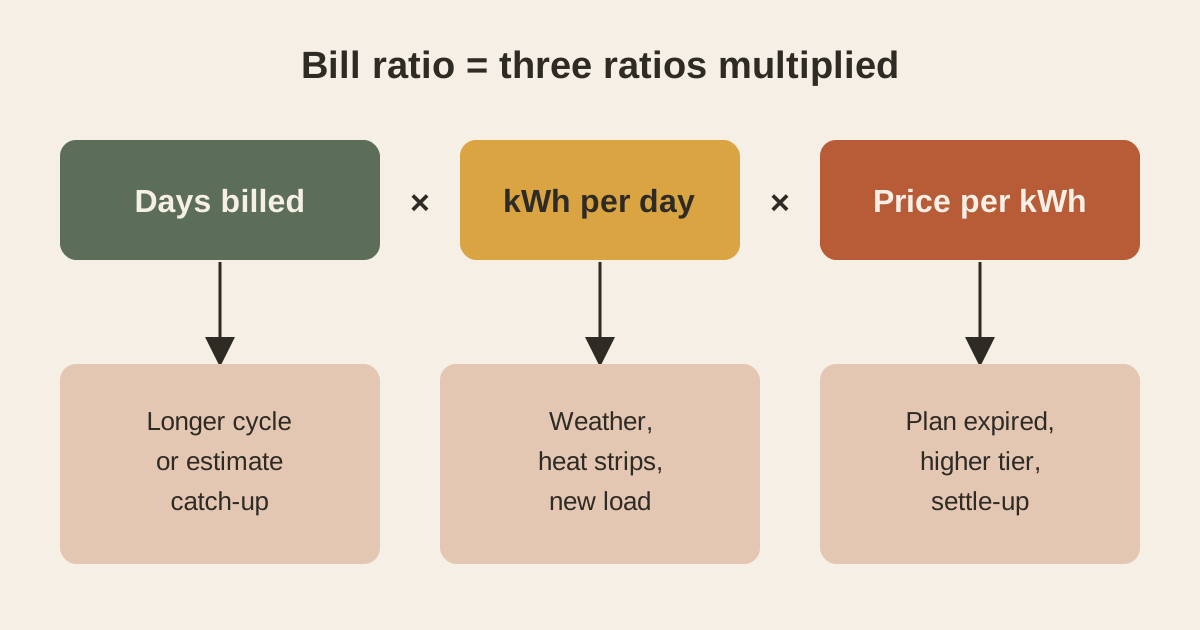
Multiply the three ratios: 1.10 × 1.20 × 1.47 = 1.94. That matches the bill ratio, $297 ÷ $153 = 1.94. The bill nearly doubled, but no single cause doubled it. Three extra days added 10%, colder weather or a heater added 20%, and the price added 47%. The price is the biggest piece, so start there.
Run your own bills through the same table. The largest ratio tells you which section below to read first.
Which number moved? A decision table
| What moved | Likely cause | What to check |
|---|---|---|
| Price per kWh (the rate printed on the bill), with kWh per day flat | Fixed-rate plan expired and rolled to a variable rate | Your contract’s expiration date and the renewal notices |
| Price per kWh, in a new season | Tiered rates or a smaller seasonal baseline | Tier lines on the bill; your utility’s rate page |
| Total, from one added line, while kWh and the rate printed on the bill look normal | Budget or equal-payment plan settle-up | “Settle-up,” “true-up,” or “adjustment” lines |
| Days billed | Longer billing cycle | Read dates; “estimated” vs. “actual” read labels |
| kWh per day, in a hot or cold month | Weather | Degree days for both bills |
| kWh per day, heat-pump home in winter | Backup heat strips running | “AUX” or “EM HEAT” on the thermostat |
| kWh per day, mild month | A new or failing load | Overnight hourly use on your utility portal |
If the price per kWh jumped
A fixed-rate plan expired
In retail-choice markets, a fixed rate lasts only as long as the contract. Texas spells out the rules in law. Under Texas House Bill 16, passed in 2021:
- Notices: your retailer must send at least three written notices of the expiration date during the last third of the contract. For a contract longer than four months, the final notice must come at least 30 days before the plan expires.
- Default plan: if you don’t pick a new plan, you move to a month-to-month default product whose price can change every billing cycle. You can cancel that default product at any time without a fee.
- Missed notices: if the retailer didn’t send proper notice, the law says it must keep charging the fixed-rate pricing until it does or until you choose another plan.
- No wholesale-indexed plans: retailers can no longer sell residential customers plans indexed to the wholesale price.
So a Texan whose price jumped after a contract ended can switch right away, with no early-termination fee on the default plan. If no notices ever arrived, ask the retailer to rebill at the old fixed price. Other states and provinces set their own rules, so check with your utility regulator.
You crossed into a higher tier, or the season changed
Tiered rates charge more for each kWh above a set allowance. Southern California Edison’s tiered plan is a clear example. As of October 2026, every billing period starts at Tier 1 (30¢ per kWh), and use above the baseline allowance costs 39¢ per kWh. Two details from SCE’s rate page catch people out:
- The allowance depends on the length of the bill. It is a daily baseline multiplied by the number of days in the billing period.
- The daily baseline changes with the season. SCE uses one baseline for June through September and another for the rest of the year.
So the same kWh can cost more in a different month because more of it lands in Tier 2. Look for the kWh billed at each tier on your bill.
A budget-billing plan settled up
Equal or levelized payment plans charge a set amount each month, then settle the difference later. Manitoba Hydro’s August bill, for example, ends its Equal Payment Plan year. That bill combines August’s charges with a credit, or with the amount owed if your actual use ran higher than your payments. If your utility has a plan like this, a large “settle-up” or “adjustment” line explains the jump, not this month’s use.
If the days or the read changed
More days on this bill
Billing periods don’t always match calendar months. Manitoba Hydro lists the number of days in a billing period, and whether a reading was actual or estimated, among the reasons a bill comes in high. Divide by days, as in the worked example, before you compare anything.
An estimated read caught up
When a meter isn’t read, the utility estimates your usage. The next actual reading corrects the estimates, and if they were too low you’re billed for the difference. Some states limit how long this can go on. Pennsylvania’s rule (52 Pa. Code §56.12) says:
- Bills should normally be based on actual meter readings by utility staff.
- With monthly billing, the utility may estimate every other month if it gives you a chance to report your own reading. Bills then have to use your reading unless it’s clearly wrong.
- If the utility can’t get access to the meter, it must get an actual or customer-supplied reading at least every 6 months (or every four billing periods) and an actual reading at least once every 12 months.
- If a rebill exceeds the normal estimate by at least 50% or $50, separate make-up bill rules apply.
To make another catch-up less likely, photograph your meter on the read date and send in the number if your utility accepts customer readings. Ask whether you can pay a large make-up bill in installments.
The meter itself
If the reads were actual and the kWh still looks impossible, you can ask for a meter test. Florida’s rule for electric utilities, for example, requires a free accuracy test on request if your meter hasn’t been tested in the past 12 months. More frequent requests can require a deposit of up to $100, which is refunded if the meter turns out to be running fast beyond the allowed limit. Ask your own utility what its rules are before paying for a test.
If your kWh per day jumped
Check the weather before the equipment
The EIA measures weather with degree days. Each day’s average temperature is compared with 65°F. Days below 65°F count as heating degree days, and days above it count as cooling degree days. For example, a day with a high of 33°F and a low of 25°F averages 29°F, which is 36 heating degree days. Some utilities print degree days on the bill. If yours doesn’t, look up the totals for both billing periods for your area.
Weather matters a lot for heating and cooling bills. Manitoba Hydro says heating and cooling alone can be more than 60% of an energy bill. If this period had far more degree days than the same period last year, a higher bill is the expected result. Weather alone doesn’t mean anything is broken.
Heat-pump homes: the backup strips
Every heat pump system includes electric resistance heat strips for backup, according to the electric cooperative GVEC, and they need a lot more energy to run than the heat pump. Two things bring them on for long stretches:
- Emergency heat: setting the thermostat to “EM HEAT” makes the system rely entirely on the strips. GVEC says not to use it unless the heat pump isn’t functioning, and even then only as a short-term solution until it’s repaired.
- Big setpoint jumps: GVEC also says raising the thermostat more than two degrees at once can bring the strips on.
New York’s energy agency, NYSERDA, says modern heat pumps are three times more efficient than electric resistance heat. Hours the strips spend doing the heat pump’s job therefore cost roughly three times as much for the same warmth. If the thermostat shows AUX or EM HEAT for long periods in mild weather, have the heat pump checked. For settings that avoid this, see thermostat settings by season.
A new or forgotten load
A portable electric heater is an easy load to overlook. Energy cost is watts × hours ÷ 1,000 × your price per kWh. Here it is for a heater drawing 1,500 W, an illustrative figure (use the wattage on your heater’s label):
1,500 W × 8 hours ÷ 1,000 = 12 kWh a day
12 kWh × 30 days = 360 kWh
360 kWh × $0.17 = about $61 a month
That’s one heater on one schedule. For other run times, see what a space heater costs for 8 hours.
If the month was mild and there’s no heater, check your utility’s hourly data for the middle of the night. High overnight use can mean something is running constantly, such as a pump that won’t shut off, a water heater, or a heater in an unused room. To find the appliance, follow which appliance is quietly using the most electricity. For a full room-by-room process, use the step-by-step high-bill checklist.
FAQ
My kWh is the same as last year. Why is the bill double?
Then the price changed. Divide the total by the kWh. If that average price roughly doubled, look for an expired fixed rate, a tier change, or a settle-up line. Also check that last year’s bill was based on an actual read and not an estimate.
Do I have to stay on the higher rate after my plan expired?
In Texas, no. The default month-to-month product can be cancelled at any time without a fee, so you can sign a new plan right away. Elsewhere, read the renewal terms in your contract or ask your regulator.
Sources
- H.B. No. 16, Texas Legislature (enrolled text) — fixed-rate expiration notices, default month-to-month product, no-fee cancellation, ban on wholesale-indexed residential plans
- 52 Pa. Code §56.12 (Cornell LII) and Fla. Admin. Code R. 25-6.059 (Cornell LII) — limits on estimated bills and customer readings; free meter test and deposit rules
- Tiered Rate Plan (Southern California Edison) — Tier 1 and Tier 2 prices, allowance = daily baseline × billing days, summer baseline
- Why your bill might be high (Manitoba Hydro) — Equal Payment Plan settle-up, billing days, estimated reads, heating and cooling share of bills
- Degree days and Average Price of Electricity (EIA) — 65°F base and degree-day example; the 17¢ average rate
- Heat Pumps, Heat Strips and Emergency Heating (GVEC) — emergency heat runs only on strips and is for a heat pump that isn’t functioning; raising the setpoint more than two degrees at once can bring strips on
- Heat Pumps for Cold Climates (NYSERDA) — modern heat pumps are three times as efficient as electric resistance heat
- Estimating Appliance and Home Electronic Energy Use (DOE) — the watts × hours ÷ 1,000 × rate formula
Written and reviewed by peter.bae for Hearth & Habit · Last reviewed October 11, 2026


Comments
Post a Comment