Does Setting the Water Heater to 120°F Instead of 140°F Actually Save Money?
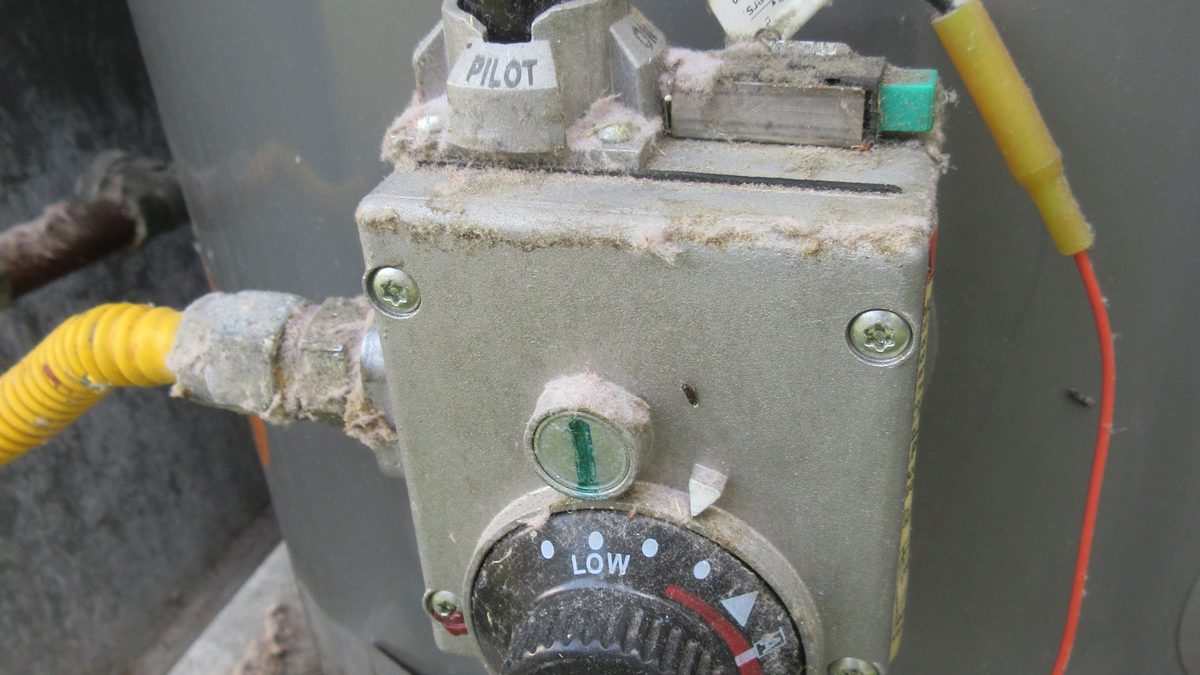
Photo: Infrogmation of New Orleans via Wikimedia Commons (CC BY-SA 4.0) · license
Yes, but modestly: dropping from 140°F to 120°F trims the excess heating a hotter tank wastes, plus the energy for anything that uses tank water unmixed. Your showers cost about the same either way.
That is the part most “turn it down and save” advice skips. It also skips the real decision, which is not about money at all. The Consumer Product Safety Commission (CPSC) wants tanks at 120°F to prevent scalds. Legionella guidance from the World Health Organization (WHO) points toward 140°F at the heater. Which way you lean depends on who lives in your house.
Where the savings actually come from
The figures you’ll see quoted measure different things, so they look contradictory:
- $36 to $61 a year. The utility We Energies says a tank set at 140°F can waste this much annually in excess heating. That is a dollar figure for keeping water hotter than you need, not a percentage of your bill.
- About 9% of water heating costs. We Energies’ estimate for keeping the heater at 120°F.
To put the 9% in perspective, University of Georgia Extension says water heating can be 15% to 20% of home energy use. Nine percent of that share (0.09 × 15 up to 0.09 × 20) works out to very roughly 1 to 2 percent of your home’s energy use. That is worth having for a free dial turn, but it won’t transform a bill. If yours jumped suddenly, the cause is probably elsewhere; this step-by-step electric bill checklist and the guide to a gas bill that rose without a thermostat change cover the bigger suspects.
Why your shower barely changes
Penn State’s energy course gives the formula for heating water: heat = pounds of water × 1 BTU per pound per °F × temperature rise. A gallon weighs about 8.3 pounds, and 3,412 BTU make one kilowatt-hour (kWh).
Now look at a shower. You mix hot and cold until it feels right. The heat in that mixed stream depends only on how many gallons you use, how warm you mix them, and how cold the incoming water is. The tank setting is not in the equation. At 120°F you simply turn the hot handle further and draw more gallons of hot water to reach the same feel.
That has a side effect people notice. Using the 55°F incoming water from Penn State’s example, each gallon stored at 140°F is (140 − 55) = 85°F above the inlet, versus (120 − 55) = 65°F at 120°F. So a tank at 140°F stretches 85 ÷ 65 ≈ 1.31 times as far for blended uses as the same tank at 120°F. If your household already runs short on hot water at the end of the morning, 120°F will make that worse. Colder winter inlet water changes the ratio, but the direction holds.
Where the dial does change the bill: unmixed hot water
A dishwasher fills from the hot line, and so does a clothes washer on its hot setting. Nobody blends those gallons down at a handle, so a hotter tank costs more for each one.
Here is the arithmetic per gallon, using Penn State’s formula and the US average electricity price of roughly 17 to 18 cents per kWh, as reported by the Energy Information Administration (EIA):
| Tank setting | Rise above 55°F inlet | BTU per gallon (8.3 × rise) | kWh per gallon (÷ 3,412) | Cost per gallon at 17¢–18¢ |
|---|---|---|---|---|
| 120°F | 65°F | 539.5 | 0.158 | 2.7¢–2.8¢ |
| 130°F | 75°F | 622.5 | 0.182 | 3.1¢–3.3¢ |
| 140°F | 85°F | 705.5 | 0.207 | 3.5¢–3.7¢ |
The 140-to-120 difference is 8.3 × 20 = 166 BTU, or 0.049 kWh, per gallon. That’s under a penny a gallon (0.8¢–0.9¢), or about 83¢ to 88¢ per 100 gallons of unmixed hot water. These figures ignore the heater’s own efficiency losses, so real costs run a bit higher. Plug in your own rate from your bill to redo the math. Gas heaters follow the same BTU math; convert the BTU to the unit on your gas bill and multiply by its price.
The real trade-off: scalds versus Legionella
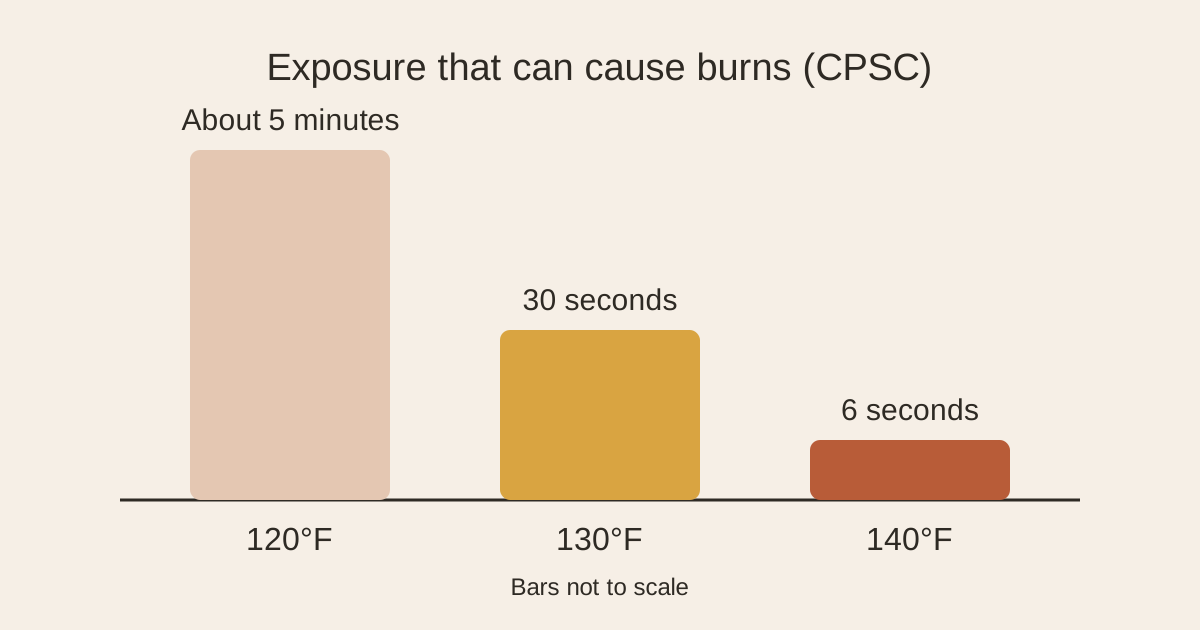
Scalds. CPSC says most adults suffer third-degree burns after two seconds in 150°F water. Burns also occur after a six-second exposure at 140°F or a thirty-second exposure at 130°F, and even at 120°F a five-minute exposure could cause third-degree burns. CPSC adds that most tap-water scald injuries and deaths happen to older adults and children under five.
Legionella. WHO says the bacteria grow in water at 20°C to 50°C (about 68°F to 122°F). It recommends that water leaving the heater be at or above 60°C, which is 140°F. A tank at 120°F sits inside that growth range. Consumer Reports, citing that risk, does not necessarily recommend 120°F. It points to OSHA’s position of 140°F at the heater, with anti-scald devices such as thermostatic mixing valves at each faucet.
WHO lists who is most at risk: adults over 50, smokers, heavy drinkers, people with chronic lung or kidney disease, and above all people with weakened immune systems.
Decision table
| Setting | Exposure that can burn (CPSC) | Legionella range (WHO) | Dishwasher | Energy |
|---|---|---|---|---|
| 120°F | About 5 minutes | Inside the 68°F–122°F growth range | Whirlpool says 120°F incoming water performs best | Cheapest of the three per unmixed gallon |
| 130°F | 30 seconds | Above the growth range, below WHO’s 140°F heater target | Above Whirlpool’s 120°F; below UGA’s 140°F advice for no-booster machines | In between |
| 140°F | 6 seconds | At WHO’s 60°C (140°F) heater target, if the tank truly reaches it | Matches UGA’s advice for dishwashers without a booster heater | We Energies: can waste $36–$61 a year |
Notice that 130°F is not the comfortable middle it sounds like. CPSC says a thirty-second exposure at that setting can already burn, and it still misses WHO’s heater target.
How to read the table for your house:
- Young children or frail older adults at home: CPSC recommends 120°F to cut scald risk. It is lower risk, not no risk: CPSC still says to hand-test water before bathing infants and young children and warns that leaving a child unsupervised in the bathroom, even for a second, could cause serious injuries. If someone in the house is also at high Legionella risk, ask a plumber about 140°F at the tank with thermostatic mixing valves at the taps rather than picking one risk over the other.
- Anyone in WHO’s higher-risk groups above, especially a weakened immune system: Lean toward 140°F at the heater, with anti-scald protection at the fixtures.
- No one in WHO’s higher-risk groups: 120°F is what CPSC and the Department of Energy recommend, and it saves a little money. Accept that it gives up WHO’s heater temperature.
- Dishwasher without a booster heater: University of Georgia Extension says to set 140°F in that case. Models with internal heaters, Whirlpool notes, run longer cycles while they heat cooler water. The cheaper drying choice is covered in our post on air-dry versus heated dry.
Set it by thermometer, not by the dial
The dial setting is a starting point, not a reading, and CPSC says to verify at the tap. Its method: hold a candy or meat thermometer under the faucet first thing in the morning, or at least two hours after anyone used hot water. We Energies suggests the sink closest to the heater. Adjust, then check again the next day.
On an electric heater, CPSC says to shut off power at the breaker before opening the access panels, and UGA Extension likewise says to turn off the electricity first. Most electric tanks have two thermostats, upper and lower, and both must be set to the same temperature. Put the covers back on before you restore power. On gas heaters, CPSC says to follow the manufacturer’s instructions for the dial, since controls differ.
While you’re at the tank, a popping or rumbling sound is a separate sediment problem worth reading about before you assume the setting is to blame.
Sources
- Avoiding Tap Water Scalds (CPSC Publication 5098) — 120°F recommendation, burn exposure times at 120, 130, 140 and 150°F, hand-testing, thermometer method, electric two-thermostat procedure
- Legionellosis (WHO fact sheet) — 20–50°C growth range, 60°C at the heater, higher-risk groups
- Smart Ways to Save on Your Hot Water Bill (Consumer Reports) — Legionella caution on 120°F, OSHA 140°F with thermostatic mixing valves
- Lower water heater thermostat (We Energies) — $36–$61 a year wasted at 140°F, about 9% savings at 120°F, test at nearest sink
- 7.3 Energy Required for Water Heating (Penn State) — heat formula, 8.3 lb per gallon, 3,412 BTU per kWh, 55°F inlet example
- Energy-Efficient Water Heating (University of Georgia Extension) — water heating’s 15%–20% share of home energy, 140°F for dishwashers without a booster heater, power off before adjusting
- Dishwasher Water Temperature Troubleshooting (Whirlpool) — 120°F incoming water performs best; internal heaters lengthen cycles
- EIA average retail price of electricity — US average residential rate used in the cost table
Written and reviewed by peter.bae for Hearth & Habit


Comments
Post a Comment