Why Does My Basement Smell Musty Only in the Summer?
Your basement smells musty only in summer because warm, humid air reaches walls and floors kept cold by the ground, and moisture condenses on them. Damp concrete, cardboard, carpet, and wood then grow the mildew you smell, and in drier months the moisture isn’t there.
Building scientist Joseph Lstiburek of Building Science Corporation puts it plainly: the main problem with below-grade walls comes during the summer. That’s when warm, moist air meets basement surfaces that sit below the air’s dew point, the temperature at which water starts condensing out of it. The concrete stays cold because it’s in direct contact with the ground.
The fix is to get the basement’s humidity down and keep it there. Here’s how to confirm that’s your problem, how to size a dehumidifier on today’s ratings (most online advice uses the old ones), and what it costs to run.
Match your smell to the cause
| What you notice | Most likely cause | First check |
|---|---|---|
| Musty only in humid weather, fine in winter | Summer condensation on cold surfaces | Hygrometer reading at or above 60% |
| Worse after heavy rain | Water getting in from outside | Damp patches low on walls; grading and downspouts |
| Strongest near boxes, a rug, or stored furniture | Damp porous materials growing mildew | Underside of the rug or pad; bottom of boxes |
| Strongest at cold wall corners behind furniture | Condensation where air can’t circulate | Pull furniture away from the wall and look |
| Dripping or wet cold-water pipes | Condensation on pipes | Pipes sweating on humid days |
The EPA notes that mold often shows up on walls in cold corners behind furniture, where condensation forms, and on the underside of carpets and pads. Those spots are worth checking before you assume the smell is “in the walls.”
A cheap digital hygrometer (a humidity gauge) settles the first row. EPA’s target is below 60% relative humidity, ideally 30 to 50%. ENERGY STAR gives the same 30 to 50% range and warns that higher levels may promote mold growth. If the basement sits at or above 60% for days in summer, humidity is your problem whether or not there’s a leak.
If you’re seeing actual water, not just damp air and a smell, deal with that first. That means grading, gutters, and possibly a professional. Downspouts should discharge at least 5 feet from the foundation, onto ground that drops roughly 6 inches over the first 10 feet. If water keeps collecting in the same low spot outside, see why water pools in one spot in the yard.
Why “airing it out” backfires in summer
Opening basement windows on a warm day feels like the obvious fix. It brings in more of the warm, moist air that causes the condensation in the first place.
Summer outdoor air is the source of the moisture. When it reaches the basement’s cold concrete, it cools, and once a surface is below that air’s dew point, water condenses on it. Lstiburek notes that moisture can be removed from a basement by ventilation or dehumidification. In humid summer weather, ventilation with outdoor air works against you, and dehumidification is the tool that works.
Keep windows and outside doors to the basement closed on humid days. Ventilating makes more sense in dry weather.
Sizing a dehumidifier on today’s ratings
The rating change most guides miss
In June 2019, the Department of Energy changed how dehumidifiers are tested. ENERGY STAR explains that portable units used to be tested at 80°F and are now tested at 65°F, which it calls conditions comparable to a basement. Cooler air holds less moisture, so the same machine now removes fewer pints in the test, and its label shows a smaller number. New-scale ratings started appearing in early 2020.
ENERGY STAR’s approximate conversions for portable units:
| Old rating (80°F test) | New rating (65°F test) |
|---|---|
| 30 pints/day | 20 pints/day |
| 40 pints/day | 25 pints/day |
| 50 pints/day | 30 pints/day |
| 55 pints/day | 30–35 pints/day |
| 60 pints/day | 35 pints/day |
| 70 pints/day | 40–45 pints/day |
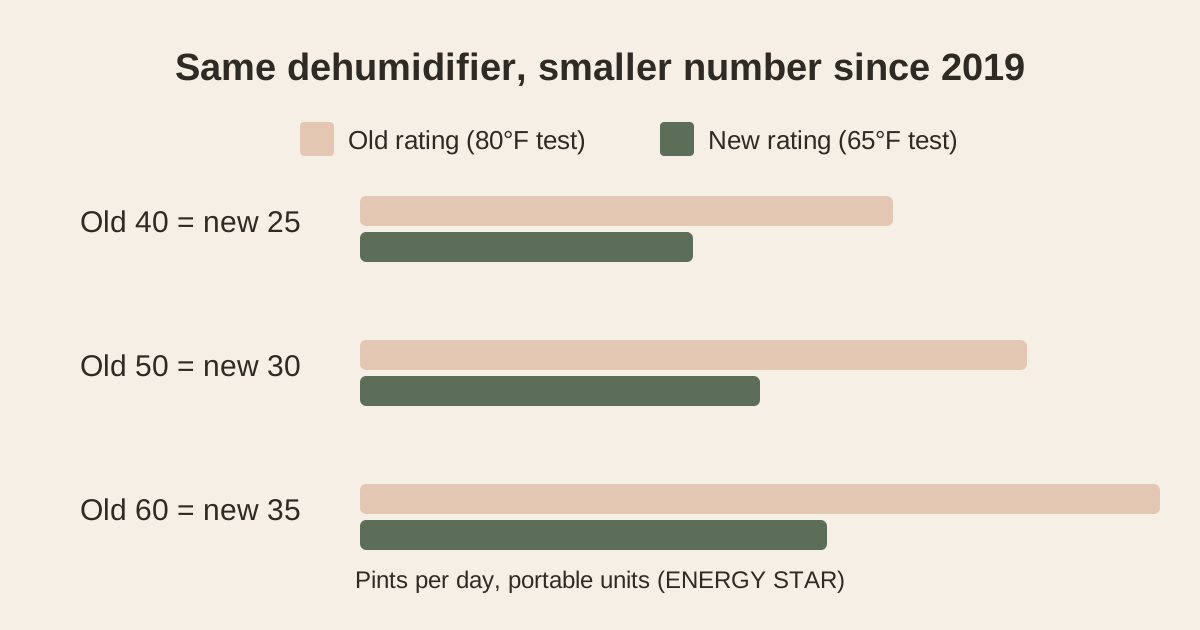
So a guide that tells you to buy “a 50-pint basement unit” was written for the old scale, and the equivalent today is about a 30-pint model. ENERGY STAR adds that actual changes vary by model.
Pick the size from your hygrometer reading
ENERGY STAR sizes dehumidifiers by how damp the space is before you start drying it, in pints per day on the new scale:
| Condition before dehumidifying | Under 2,000 sq ft | Over 2,000 sq ft |
|---|---|---|
| Slightly to moderately damp (50–75% RH) | 20–30 | 30+ |
| Very damp (75–90% RH) | 25–40 | 40+ |
| Wet, including laundry drying (90–100% RH) | 30–50 | 50+ |
A worked example: a 1,000-square-foot basement where the hygrometer sits around 70% in July falls in the first row, under 2,000 square feet, so ENERGY STAR’s range is 20 to 30 pints a day. ENERGY STAR says it’s better to oversize than undersize, which points to the top of that range, a 30-pint unit. On the old scale that’s the size once sold as 50 pints.
If you’re replacing a unit, ENERGY STAR suggests looking at how much water you’re emptying each day as a guide to capacity.
Set the humidistat to land in the 30 to 50% range. If the unit’s own display doesn’t show relative humidity, check with the hygrometer.
One limitation in cool basements
ENERGY STAR notes that frost can form on a dehumidifier’s coils, typically when the air drops below 65°F. If you see frost, switch the unit off and let it defrost before restarting.
What running a dehumidifier costs
Efficiency is rated as an Integrated Energy Factor (IEF): liters of water removed per kilowatt-hour of electricity, measured under test conditions. ENERGY STAR requires at least 2.01 liters per kWh for portable units rated between 25.01 and 50 pints a day. ENERGY STAR-certified units use about 20% less energy than conventional ones removing the same amount of water.
That gives a formula you can redo with your own numbers:
kWh = liters removed ÷ IEF, then cost = kWh × your electricity rate
Say a 30-pint unit pulls out 20 pints on a muggy day (check the bucket):
- 20 pints × 0.473 liters per pint ≈ 9.5 liters
- 9.5 ÷ 2.01 ≈ 4.7 kWh
- 4.7 kWh × $0.17 to $0.18 per kWh (the US average residential range) ≈ $0.80 to $0.85 a day
- 30 days of that ≈ $24 to $25 a month
A unit more efficient than the ENERGY STAR minimum costs less. A drier day removes less water and costs less too. To see how this stacks up against everything else on your bill, here’s which appliance is quietly using the most electricity.
Other changes that cut summer moisture
- Insulate sweating cold-water pipes. EPA recommends covering cold surfaces such as cold water pipes with insulation.
- Vent the dryer outside. EPA and ENERGY STAR both say to vent clothes dryers outdoors. ENERGY STAR also suggests drying clothes outside rather than indoors. A laundry rack in the basement adds water the dehumidifier then has to remove.
- Get storage off the floor. Shelving and plastic bins keep cardboard off concrete. Cardboard soaks up moisture and gives mildew something to grow on. The same thing happens in a closet that smells musty even though it looks clean.
- Dry anything wet within 24 to 48 hours. That’s EPA’s window for preventing mold growth on wet materials.
- Watch what you seal the walls and floor with. Lstiburek warns against impermeable interior finishes on basement walls and floors, such as vinyl floor coverings, vinyl wall coverings, and oil (alkyd) paints. They stop the concrete from drying toward the inside.
- Keep the outside draining away. ENERGY STAR’s list of basement moisture tips includes extending downspouts, keeping gutters clear, sloping soil away from the foundation, not overwatering foundation plantings, and fixing leaking outdoor faucets.
When to stop managing it yourself
- Mold you can see over about 10 square feet (roughly 3 feet by 3 feet), mold in ductwork, or mold after sewage or floodwater. That’s past EPA’s guideline for homeowner cleanup.
- Moldy carpet or ceiling tiles. EPA says absorbent materials like these may have to be thrown away if they become moldy, rather than cleaned.
- Standing water or a leak that the dehumidifier can’t keep up with.
- A smell that stays after weeks at 30 to 50%. At that point the source is likely a wet material or hidden water, not the air.
If you clean small spots yourself, never mix bleach with cleaners that contain ammonia. EPA warns that the combination creates toxic fumes. To track down a smell that’s spread beyond the basement, use our room-by-room guide to finding a musty smell.
FAQ
Why does the smell go away in winter?
Cold outdoor air carries much less moisture, so there’s far less to condense on the basement’s cold surfaces. The mildew doesn’t vanish. It needs moisture to grow, so the smell returns when summer humidity does.
Will an air purifier fix it?
Not on its own. A purifier filters particles from the air, but the smell comes from damp surfaces and materials. EPA’s tools for moisture are air conditioners, dehumidifiers, venting, and drying wet items, so lower the humidity first.
Should the dehumidifier run all summer?
Let the humidistat decide. Set it to keep the space in the 30 to 50% range, and it will cycle off when the air is dry enough. Plumbing the drain hose to a floor drain or sump means a full bucket can’t shut it off.
Sources
- BSD-103: Understanding Basements (Building Science Corporation) — summer condensation on cold below-grade surfaces; ventilation vs. dehumidification; impermeable finishes
- Dehumidifiers (ENERGY STAR) — sizing chart, 30–50% target, coil frost below 65°F, 20% energy savings, basement moisture tips
- ENERGY STAR: Dehumidifier Testing and Capacity and Key Efficiency Criteria — the 2019 test change, old-to-new rating conversions, minimum IEF
- Mold Course Chapter 2 (US EPA) — condensation on cold surfaces, cold corners behind furniture, 24–48 hour drying window
- A Brief Guide to Mold, Moisture and Your Home (US EPA) — humidity below 60%, pipe insulation, venting dryers, porous materials, bleach and ammonia
- Mold Cleanup in Your Home (US EPA) — the roughly 10-square-foot homeowner cleanup limit
- Stormwater: Gutters and Downspouts (DOE Building Science Education) — downspouts at least 5 feet out, slope away from the house
- Electric Power Monthly, average residential price (EIA) — the 17–18 cents per kWh average used in the cost math
Written and reviewed by peter.bae for Hearth & Habit · Last reviewed October 11, 2026


Comments
Post a Comment