Why Does My Circuit Breaker Trip Only When Two Specific Appliances Run Together?
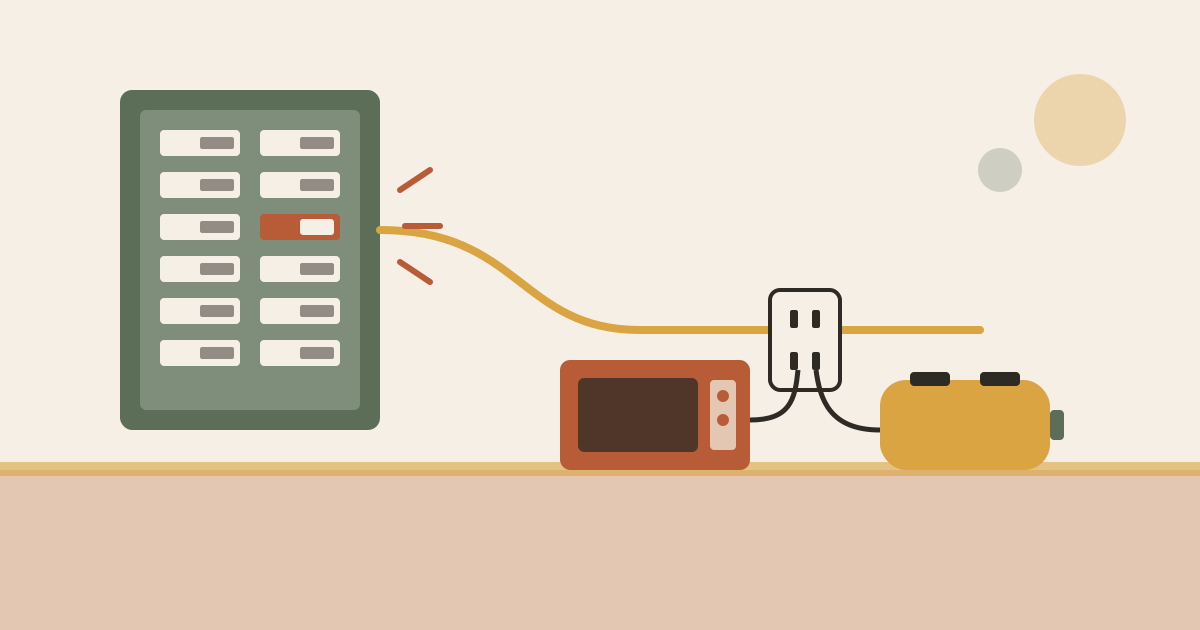
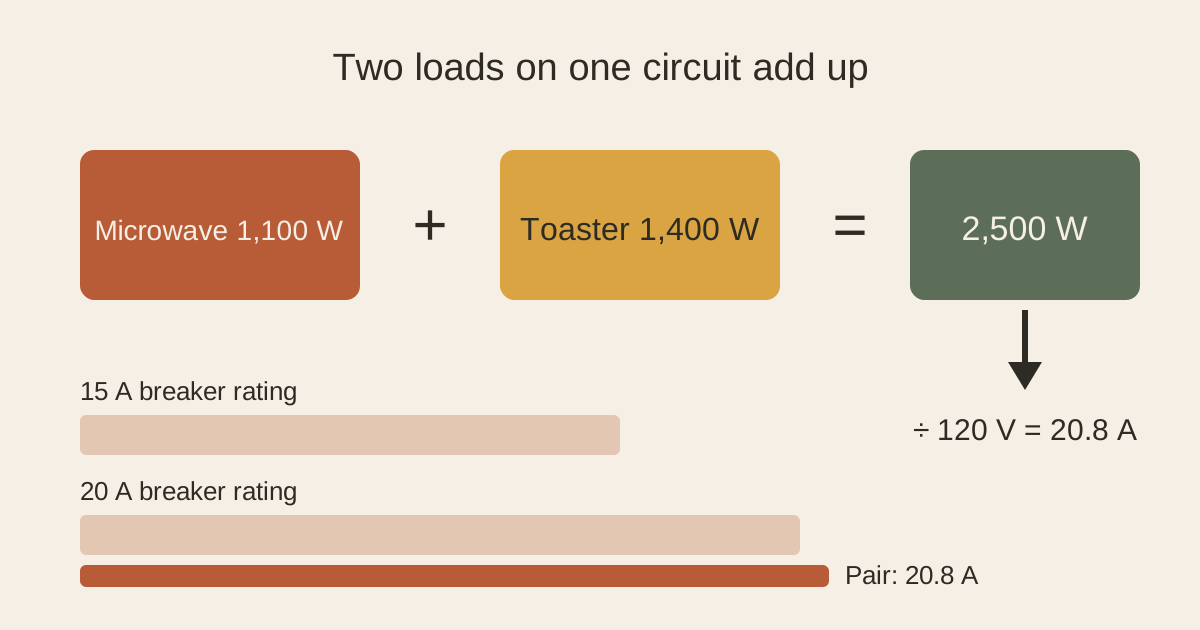
Usually the two appliances share one circuit, and together they draw more current than its breaker is rated for. A 1,100-watt microwave and a 1,400-watt toaster add up to about 20.8 amps, which is more than a 15-amp or a 20-amp breaker is rated to carry.
That’s the common case, and it’s fixable without tools. But the same symptom can also mean a failing appliance or a circuit with a problem. The checklist below sorts out which one you have, starting with checks that take a minute.
First, confirm it really is an overload
It trips only after the pair has run for a bit
Breakers such as Square D’s load-center models have two ways to trip. Square D’s breakers trip from heat built up by a sustained, low-level overload, or quickly when a magnetic coil senses the high current of a short circuit. An overload trip is the slow kind. The breaker heats up while both appliances run, then shuts off. If yours trips some time after the second appliance starts, that fits an overload.
If the breaker trips the instant you reset it, or with nothing running at all, stop resetting it. A quick trip matches the short-circuit side of that description, not an overload, so call an electrician.
Each appliance runs fine alone, in any outlet
UL Solutions gives a simple test. If an appliance trips the breaker no matter which outlet it’s plugged into, the appliance is the likely culprit. To try that idea, plug each one, alone, into an outlet on a different breaker. If one appliance trips breakers by itself, stop using it until it has been checked. If each runs fine alone and only the pair trips one breaker, keep going.
You know it was the panel breaker that tripped
Check which device shut off. This guide is about a breaker in the main panel. If instead a GFCI outlet shut off, a different device tripped. UL describes GFCIs as special shock-resistant outlets for kitchens and bathrooms, which is a different job from a breaker’s overload protection. This checklist doesn’t cover GFCI trips.
Do the arithmetic
Read the nameplates
Virginia Cooperative Extension says most appliances have their wattage stamped on the bottom, the back, or a nameplate. If no wattage is listed, Extension’s method is to take the appliance’s current in amps and multiply it by the voltage. Extension notes that most US appliances run on 120 volts. Going the other way, divide watts by 120 to get amps, add the amps for both appliances, and compare the total with the rating printed on the breaker handle, such as 15 or 20.
The 1,500-watt ceramic heater sold by Lowe’s (model NT15-20A) shows the math in its manual: it’s rated 12.5 amps at 1,500 watts and 120 volts. That one appliance uses most of a 15-amp breaker by itself. The U.S. Army’s safety center makes the same point. With a heater drawing about 12.5 amps, a 15-amp breaker can handle only one such heater, and very little else can be on while it runs.
Common pairs, added up
The table uses Virginia Cooperative Extension’s typical wattage ranges. Each pair is added at the low end and the high end of those ranges, then divided by 120 volts. Your own appliances may sit anywhere in a range, so use your nameplates.
| Pair | Typical watts (low + low to high + high) | Amps at 120 V | Over a 15 A rating? | Over a 20 A rating? |
|---|---|---|---|---|
| Microwave (750–1,100 W) + toaster (800–1,400 W) | 1,550–2,500 W | 12.9–20.8 A | At the high end | At the high end |
| Microwave (750–1,100 W) + coffee maker (900–1,200 W) | 1,650–2,300 W | 13.8–19.2 A | At the high end | No |
| Toaster oven (1,225 W) + coffee maker (900–1,200 W) | 2,125–2,425 W | 17.7–20.2 A | Yes, across the range | At the high end |
| Portable heater (750–1,500 W) + vacuum (1,000–1,440 W) | 1,750–2,940 W | 14.6–24.5 A | At the high end | At the high end |
| Portable heater (750–1,500 W) + hair dryer (1,200–1,875 W) | 1,950–3,375 W | 16.3–28.1 A | Yes, across the range | At the high end |
Settings matter too. Virginia Cooperative Extension says actual power use depends on the setting, and the worked example below shows how much a heater’s low setting changes the total.
Anything else running on the circuit adds to the pair. Extension lists a 16-cubic-foot frost-free refrigerator at 725 watts, which is about 6 amps (725 ÷ 120). If a fridge shares the kitchen circuit, its draw adds to the pair’s whenever it’s running.
Worked example: the low setting on a heater
That Lowe’s heater has three settings: 700, 900, and 1,500 watts. Here is the same heater sharing a circuit with a 1,100-watt microwave:
High: (1,500 W + 1,100 W) ÷ 120 V = 2,600 ÷ 120 = 21.7 A
Low: (700 W + 1,100 W) ÷ 120 V = 1,800 ÷ 120 = 15.0 A
On high, the pair is over a 20-amp breaker’s rating. On low, it’s right at a 15-amp breaker’s rating, with no room for a light or a fridge. Turning the heater down helps, but it doesn’t make the circuit big enough. The heater’s manual still says not to plug it into a circuit that already has other appliances working. For what that heater costs to run at each setting, see what it costs to run a space heater for 8 hours.
Find out what shares the circuit
Map the outlets on that breaker
With the tripped breaker off, walk the house and note every outlet and light that’s dead. That list is the circuit. Check beyond the room you’re in, including the next room, the hallway, and the outlet behind the fridge. Write the list down and keep it near the panel so the next trip is quicker to diagnose.
Note what else is plugged in and running
Anything on that list counts toward the total, including a fridge, a dehumidifier, or a space heater in the next room. If you’re not sure what draws the most, which appliance is quietly using the most electricity walks through reading labels and using a plug-in meter.
Watch the lights when the second appliance starts
UL notes that light fixtures draw only a little power, so lights that flicker or dim usually mean high-draw appliances or space heaters are on the same circuit. That makes dimming a clue to what shares the circuit. NFPA also lists flickering or dimming lights as a reason to call an electrician, so if it keeps happening, see the last section.
Fixes that work
Run the two appliances one after the other
This fix costs nothing. Toast first, then microwave. Dry your hair, then turn the bathroom heater back on.
Move one to a different circuit, plugged straight into the wall
Use your outlet map to pick an outlet on a different breaker. Plug the appliance directly into it. NFPA guidance says extension cords and plug strips should not be used for major appliances, because they are not meant to carry such large loads. LG’s installation manual for its LMH2235ST microwave also says not to use an extension cord.
Keep one heat-producing appliance per outlet
NFPA advises plugging only one heat-producing appliance into a receptacle at a time. Its examples include coffee makers, toasters, and space heaters. A double outlet with a kettle in one side and a toaster in the other breaks that rule, even before the breaker trips.
Give the big one its own circuit
Some appliances are meant to have a circuit to themselves. LG’s installation manual for its LMH2235ST over-the-range microwave says the outlet should be on a circuit dedicated to the microwave, with a 15- or 20-amp supply. If an over-the-range model like that one shares a breaker with the countertop outlets, it may not be installed the way its manual specifies. Adding a circuit is electrician work.
When to stop and call an electrician
Swapping in a bigger breaker is not on the list of fixes. UL says a circuit that keeps overloading needs a professional to upgrade it or add a line.
Call a qualified electrician, or your landlord if you rent, when you notice any of the signs on NFPA’s list:
- Breakers that trip or fuses that blow often
- A tingling feeling when you touch an appliance
- Wall outlets that are discolored or warm
- A burning or rubbery smell from an appliance
- Lights that flicker or dim
- Sparks from an outlet
UL adds that if an outlet is uncomfortably hot, turn off the device and try another outlet. If it gets hot with nothing plugged in, UL says it may be wired incorrectly and you should consult an electrician. Not sure whether your situation is a DIY job? How to know if a repair is worth calling a pro for can help you decide. For the breaker itself, though, the rule is simple. Moving plugs and changing habits is DIY. Anything inside the panel is not.
Sources
- Estimating Appliance and Home Electronic Energy Use (Virginia Cooperative Extension) — where to find nameplate wattage, multiplying amps by volts, 120 volts, wattage ranges used in the table, settings changing draw
- 1500W Ceramic Heater (Model NT15-20A) manual (Lowe’s) — 12.5 amps at 1,500 watts and 120 volts, 700/900/1,500-watt settings, no other working appliances on the circuit
- Electrical space heaters (U.S. Army Combat Readiness/Safety Center) — a 15-amp breaker can handle only one such heater and very little else
- Square D Load-Center Circuit Breakers (McMaster-Carr catalog) — breakers trip from heat on sustained overload and quickly on a short circuit
- 8 Signs You May Have a Problem with Your Electrical Wiring (UL Solutions) — appliance-vs-circuit test, dimming lights, hot outlets, GFCIs, overloaded circuits needing a professional
- Electrical Safety tip sheet (NFPA, distributed by the Kentucky State Fire Marshal) — signs that call for an electrician
- Top 9 Electrical Safety Tips to Help Prevent Electrical Fires (Southwire) — NFPA’s one-heat-producing-appliance rule and its warning on extension cords and plug strips
- LMH2235ST over-the-range microwave installation manual (LG) — dedicated 15- or 20-amp microwave circuit, no extension cord
Written and reviewed by peter.bae for Hearth & Habit


Comments
Post a Comment