Is It Cheaper to Preheat the Oven or Skip It for Weeknight Meals?
Skipping preheat is cheaper, but only by a few cents, and on anything baked it can hurt the results. The better saving is making the preheat itself shorter, and that’s free.
Here’s the evidence. Whirlpool’s preheat times let you price your own oven’s preheat without guessing its wattage. Federal survey data shows how small the whole cooking bill is. And the same manufacturer lists a few habits that quietly stretch every preheat.
How long a preheat really takes
Whirlpool’s support pages give measured numbers. Getting to 350°F takes:
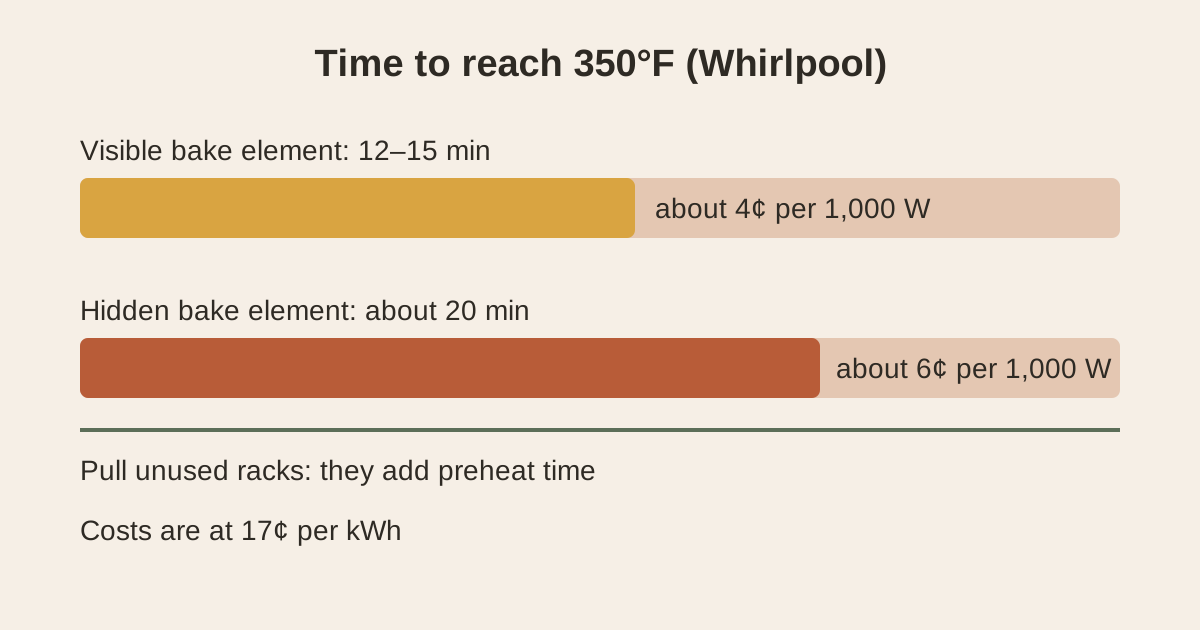
- 12–15 minutes (give or take 5) in an oven with a visible bake element, the coil on the oven floor
- about 20 minutes (give or take 5) in an oven with a hidden bake element under a smooth floor
Higher temperatures take longer. So a 425°F roast preheat runs past those figures.
What a preheat costs: price it per 1,000 watts
Energy cost is watts × hours ÷ 1,000 × your price per kWh. That’s the Department of Energy’s formula, and the US average residential price is roughly 17–18¢ per kWh, according to the Energy Information Administration (EIA). Your oven’s wattage is on its rating plate or in the manual. That figure is the maximum draw, so the result below is an upper bound.
Work it out per 1,000 watts of oven, then multiply by your oven’s rating in kilowatts:
| Oven type (Whirlpool time to 350°F) | Math per 1,000 W at 17¢ | Cost per 1,000 W |
|---|---|---|
| Visible element, 15 minutes | 1,000 × 0.25 h ÷ 1,000 = 0.25 kWh × $0.17 | about 4¢ |
| Hidden element, 20 minutes | 1,000 × 0.33 h ÷ 1,000 = 0.33 kWh × $0.17 | about 6¢ |
If your rating plate says 3,000 watts, that’s three times the per-1,000 W figure. Use your own rate from your bill: EIA data shows state averages from about 11¢ to over 40¢ per kWh.
Now the yearly view. Preheat five weeknights a week and that’s 5 × 52 = 260 preheats. At 15 minutes each:
- 260 × 0.25 kWh = 65 kWh per 1,000 W of oven
- 65 × $0.17 = about $11 a year per 1,000 W
Skipping the preheat doesn’t save all of that. The oven still has to heat up, just with the food already inside, so the dish spends that warm-up time in the oven too. What you save is the stretch where an empty oven sits at temperature waiting for you.
The ceiling on any oven saving
The EIA’s household energy survey shows how small the stakes are. Homes that cook with electricity use an average of 290 kWh a year for cooking. That covers ranges, cooktops and ovens together, but not microwaves. An average household uses about 10,500 kWh of electricity a year in total, so cooking is under 3% of it.
At 17–18¢, 290 kWh is roughly $49 to $52 a year for all electric cooking: every burner, every bake, every preheat. Skipping preheat can only trim a slice of that. If a high electric bill is what sent you here, cooking’s small average share makes the oven an unlikely main cause. Our guide to which appliance is quietly using the most electricity shows where the bigger numbers are.
Make every preheat shorter (free)
Whirlpool’s troubleshooting page for slow preheats lists the things that stretch it. Each one costs you on every use:
- Pull racks you aren’t using. Whirlpool says unused racks left in the oven add to the preheat time. Its 12–15 minute figure assumes all racks in, so taking out the extras is a quick improvement.
- Keep the door shut during preheat. Opening it lets heat escape, and Whirlpool says repeated opening can extend the preheat.
- Don’t line the oven floor or a whole rack with foil. Whirlpool says this can block airflow.
- Know your voltage. Whirlpool notes that an electric range on 208 volts preheats more slowly than one on 240 volts. Buildings with elevators typically supply 208 V, so a long preheat in an apartment may be normal for that oven, not a fault.
The door rule matters after preheat too. Whirlpool says to limit door openings and check progress with the oven light, because opening the door lets heat escape and disrupts how the elements cycle.
When to skip it and when not to
Whirlpool’s position for baking is plain: preheating is necessary for good results. Let the oven fully preheat and don’t put food in until the preheat tone sounds. Most of the trade-off is about the food, not the money.
| Dish | Skip preheat? | Why |
|---|---|---|
| Cookies, cakes, quick breads, biscuits, bread | No | Whirlpool says baking needs a full preheat for good results |
| Anything that should brown or crisp: roasted vegetables, chicken skin, pizza | No | Browning and crisping need the oven at temperature when the food goes in |
| Short bakes, shorter than your oven’s own preheat time | No | With a 12–20 minute warm-up, the oven would spend much of the bake still heating |
| Braises and pot roasts with a long cook time | Usually fine | The warm-up is a small share of a long cook |
| Casseroles and baked pasta that are already cooked, with no crisp topping wanted | Usually fine | You’re heating through, not setting a texture. Check doneness with a thermometer |
| Reheating leftovers | Fine | Heat them to 165°F measured with a food thermometer, as USDA advises |
| Frozen foods | Follow the package | Package directions usually say whether to preheat |
Whichever you choose, judge doneness by temperature, not by look, smell or the clock. A cold start changes timing, so a recipe’s time no longer fits. Our guide to how long leftovers really last covers the reheating side.
Gas ovens
Whirlpool’s preheat page above covers its ranges, and its voltage note applies to electric ones. A gas oven also has to heat its empty cavity, so the rack, door, and foil habits are worth trying there too. To price a preheat, you need the burner’s rating from the manual and the gas rate on your bill. The sources here don’t give gas preheat times, so time your own oven once. If your gas bill jumped this winter, see why a gas bill climbs without a thermostat change.
FAQ
Is it safe to start food in a cold oven?
The sources here don’t address cold starts directly. What you can control is the end point: cook or reheat to a safe internal temperature checked with a food thermometer, which is 165°F for leftovers, per USDA. Expect the cook time to run longer than the recipe says, and don’t judge doneness by the clock.
Why does my new oven take longer to preheat than my old one?
Whirlpool’s figures suggest the element type is a common reason. Hidden-element ovens, with a smooth floor, take about 20 minutes to reach 350°F, against 12–15 minutes for a visible coil. Extra racks and a 208-volt supply also slow it down.
Does opening the door once to put the food in waste much?
Whirlpool’s guidance is to wait for the preheat tone, put the food in, and then keep the door closed, using the oven light to check. The heat lost when you load the dish is part of normal use. What adds up is repeated peeking during preheat and cooking.
Sources
- Long Preheat Times - Range | Whirlpool Product Help — 12–15 and 20-minute preheat times, unused racks, door opening, foil, 208 V vs 240 V
- Long Bake Times - Range | Whirlpool Product Help — preheating necessary for good results, wait for the tone, oven light instead of opening the door
- Table CE5.3b, 2020 Residential Energy Consumption Survey | EIA and Electricity use in homes | EIA — 290 kWh a year for cooking, about 10,500 kWh total per household
- Average Price of Electricity to Ultimate Customers | EIA — roughly 17–18¢ per kWh residential average
- Estimating Appliance and Home Electronic Energy Use | DOE — watts × hours ÷ 1,000 × rate; nameplate is maximum draw
- Leftovers and Food Safety | USDA FSIS — reheat leftovers to 165°F
Written and reviewed by peter.bae for Hearth & Habit · Last reviewed October 11, 2026


Comments
Post a Comment