Where to Put Clothes You've Worn Once (But Aren't Dirty Yet)
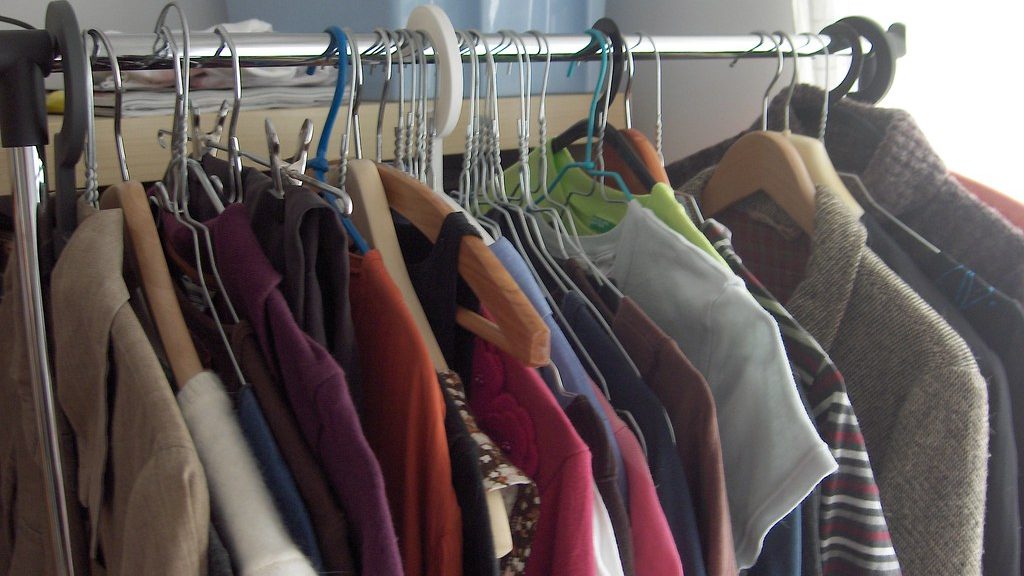
Photo: Sofy Marquez via Flickr (CC BY 2.0) · license
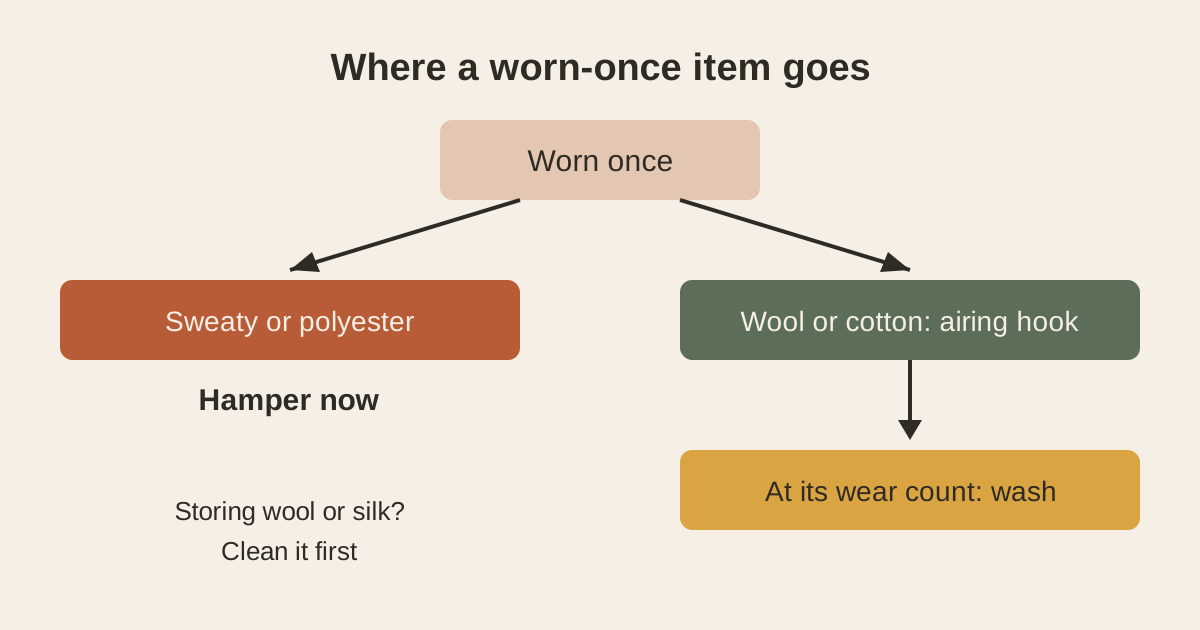
Hang worn-once clothes on one small, open “airing” hook or shelf, and wash them on a wear count, not a hunch: jeans, slacks, and sweaters every 3 to 4 wears, workout clothes and T-shirts after every wear. Two details change the answer for a given item: what it’s made of, and whether it’s headed into long-term storage.
The wear counts come from the American Cleaning Institute, the cleaning-products trade group, as passed on by Utah State University Extension. The fiber and storage details come from University of Alberta textile research and from two extension entomology pages. Together they explain why the chair pile forms and how to retire it.
How many wears each item gets
Here is the American Cleaning Institute’s schedule as USU Extension presents it:
- Every wear: leggings, tights, yoga pants and other exercise clothing, T-shirts, socks, undershirts, underwear, swimsuits.
- Every 3 to 4 wears: jeans, slacks, skirts, dresses, sweaters, bras, slips, pajamas.
- Every 3 months: outerwear, jackets, vests.
- Monthly: bathrobes.
- Once or twice a year: heavy coats.
These are defaults, and denim is one place makers stretch them. Levi’s care page says to wash its denim after approximately every 10 wears, mainly to keep the shape and fit, and to spot-clean small marks with a damp cloth, a soft brush, and mild soap in between. Read the 3-to-4 count as the general guideline and Levi’s 10 as the maker’s own figure for its denim.
Neither source sets a count for blazers or suits. Treat them like the jackets they sit closest to, and send them out when they look or smell like they need it.
Why airing works on wool but not on polyester
Hanging a sweater over a chair overnight sometimes clears a smell and sometimes doesn’t. Fiber is a big part of why.
University of Alberta textile scientist Rachel McQueen and colleagues exposed different fibers to odor compounds from simulated sweat. Here is what they found:
- Cotton and viscose absorbed and released smaller amounts of odor compounds.
- Polyester, nylon, and wool absorbed more and gave off more at first.
- Nylon and wool let the odor go faster. After 24 hours they were much lower and close to cotton.
- Polyester held on.
McQueen’s practical read is that polyester needs washing, while nylon and wool garments can often be freshened by airing instead of laundering after every wear. So a wool sweater on an airing hook for a day is doing real work. A polyester gym top on the same hook is only waiting for the hamper.
The garment table
This combines the wear counts with the fiber findings and the storage cautions covered below.
| Item | Wash after (ACI via USU) | Does a night of airing help? | Before it goes back in the closet |
|---|---|---|---|
| Jeans, cotton slacks | 3–4 wears (Levi’s: about 10 for its denim) | Less needed; cotton holds less odor to begin with | Spot-clean marks first |
| Wool or nylon sweaters | 3–4 wears | Yes; odor near cotton levels after 24 hours (U of Alberta) | Clean before seasonal storage (moths) |
| Polyester tops, fleece, activewear | Every wear for exercise clothes | Little; polyester holds odor | Straight to the hamper |
| T-shirts, underwear, socks | Every wear | Not relevant | Hamper |
| Pajamas | 3–4 wears | Some, depending on fiber | Back on the hook, not the drawer |
| Dresses, skirts | 3–4 wears | Depends on fiber; check the label | Closet once aired |
| Jackets, outerwear | Every 3 months | Depends on fiber | Closet |
| Heavy coats | Once or twice a year | Depends on fiber | Wool: clean before off-season storage (moths) |
| Silk | Not listed by ACI | Follow the care label | Clean before storage (moths) |
Is putting worn clothes back with clean ones unhygienic?
For a healthy wearer, less than it feels. In an informal University of Alberta test, a student wore one pair of raw denim jeans for 15 months and one week without washing. Researchers then counted the bacteria:
- Crotch: 8,000 to 10,000 colony-forming units (CFU, a count of live bacteria) per square centimeter.
- Back: 1,500 to 2,500.
- Front: 1,000 to 2,000.
The bacteria were mostly normal skin bacteria, and the researchers found no E. coli. About two weeks after a wash, the count was nearly the same.
The limits are stated plainly, too. It was one pair of jeans and one wearer, and the student aired them about three times a week. McQueen doesn’t recommend waiting a year to wash, and the result assumes skin without cuts or abrasions. The useful takeaway is narrow: lightly worn jeans mostly carry the wearer’s own normal skin bacteria.
Freezing jeans, a common internet fix, doesn’t help. A Stanford microbiologist tested it for NBC Bay Area and found about the same amount of bacteria after freezing. The lab freezer was much colder than a home freezer.
The real risks: moths and damp
The problem with tucking worn clothes away is what they attract.
Clothes moths. Mississippi State University Extension says wool, silk, fur, and other animal-origin fabrics are the ones at risk. Items soiled with sweat, dandruff, and other stains are especially attractive to egg-laying moths. USU Extension adds that the larvae, which do the damage, prefer fabric stained with beverages, oil, and sweat. Webbing clothes moth larvae can keep feeding for anywhere from 35 days to 2½ years.
The extension advice is aimed at storage: a sweater folded into a bin for the summer, not one on a hook you’ll empty this week. Mississippi State says to clean susceptible clothing before storing it. USU adds that storage should be clean and airtight.
Damp. Anything that goes back in the closet should be fully dry, because moisture is what mold needs. EPA advises keeping indoor relative humidity below 60%, ideally 30 to 50%, to limit mold. If yours already smells, start with why a closet smells musty even when everything looks clean.
Set up the airing spot so it doesn’t become the chair
The chair pile forms because a worn item has no assigned place, so it lands on whatever surface is nearest. Assigning one spot fixes the location. A wear count fixes the indecision.
- Pick one open spot near the closet. A wall hook, an over-door rack, or one open shelf works. Keep it visible: a closed drawer hides things, and an open hook lets air reach the fabric.
- Space items out. Air has to reach both sides of a garment, so don’t stack sweaters on one hook. If the spot is full, something goes to the closet or the wash before anything new goes up.
- Track wears. A clothespin clipped to the hanger, moved one notch per wear, or a small tally on a sticky note is enough. When jeans hit their count, they go in the wash whether they smell or not.
- Empty it once a week. Fold this into your 15-minute weekly home reset. Anything still on the hook after a week either goes back in the closet or into the hamper.
- Hamper first for these: anything polyester you sweated in, anything with a food or drink spot, and wool or silk headed into storage.
Deciding once where things go is the same idea as the one-touch rule, applied to the gray zone between closet and hamper.
FAQ
My clothes still smell after washing. Is that the same problem?
Not quite. Polyester holding onto body odor can be part of it; the Alberta research found it held odor longer than wool or nylon. A washer that leaves clothes smelling musty is a different issue, covered in why laundry still smells musty after a full wash.
Does a fabric refresher spray count as a wash?
None of these sources tested sprays, and they don’t change the wear counts above. If a polyester top smells after one wear, the fiber research points to a wash, not a spray.
How long should something air before it goes back in the closet?
The Alberta study measured odor on wool and nylon after 24 hours, and both were close to cotton by then. A full day on an open hook is a reasonable window for those fibers. Polyester didn’t clear that way.
Sources
- Ask an Expert – The Dirt on Laundry: How Often to Wash? | USU Extension — American Cleaning Institute wear counts by garment
- Denim care and washing | Levi’s — about every 10 wears for denim; spot cleaning
- New research on why some clothes get smellier | University of Alberta and Jeans remain surprisingly clean after a year of wear | University of Alberta — odor by fiber and the 24-hour result; bacteria counts on unwashed jeans
- Can You Really Clean Your Jeans By Freezing Them? | NBC Bay Area — Stanford microbiologist’s freezing test
- Webbing Clothes Moth | Mississippi State University Extension and Clothes Moths | USU Extension — soiled wool and silk attract moths; clean before storage
- A Brief Guide to Mold, Moisture, and Your Home | US EPA — indoor humidity below 60%, ideally 30–50%
Written and reviewed by peter.bae for Hearth & Habit · Last reviewed October 11, 2026


Comments
Post a Comment