How to Organize a Junk Drawer So It Actually Stays Organized

To make a junk drawer stay organized, empty it, give it one job with a written list of what belongs, sort what’s left by task, and check it against the list at the same time each week. While it’s empty, take the loose batteries out of the jumble, because that’s where a junk drawer turns from annoying to unsafe.
Most organizing guides stop at bins and dividers. Bins make the drawer look tidy on day one. A written job, a fixed check-in, and safe battery storage are what keep it that way.
Why the drawer keeps refilling
A junk drawer fills with single, odd items that don’t have an address anywhere else: a spare key, a twist tie, one AA battery, the Allen key from a bookshelf. Clear it without giving those items a home and the same kinds of things drift back.
Harvard Health’s memory advice explains part of the cycle. It describes absentmindedness as forgetting that happens when you don’t pay attention as you set something down, so your brain never records where it went. Things tossed into a jumbled drawer “for now” are hard to find again for exactly that reason. Its fix is to designate a place for the items you use often. A keep-list does that for the drawer: every item on it has a spot, and anything not on it is a visitor.
The other part is timing. A drawer that only gets attention when it’s overflowing is due for a big cleanout every few months. A drawer that gets a short check on a fixed cue is less likely to get that far.
Step 1: Empty it and triage every item
Pull the drawer out if it comes out, or dump it onto a towel. Wipe out crumbs and sticky spots while it’s empty. Then handle each item once using the table below.
Junk drawer triage table
| Item | Keep in the drawer? | What to do |
|---|---|---|
| Scissors, box cutter, tape, bag clips | Yes | “Open and close” group, front of the drawer |
| Two working pens, a marker, a notepad | Yes | “Write” group; toss dried-out pens |
| Small tape measure, mini screwdriver | Yes, if used here | “Fix and measure” group; bigger tools go to the toolbox |
| Spare AA/AAA alkaline batteries, new | Yes, in their package or a lidded box | Keep them away from loose metal items |
| Used alkaline batteries | No | EPA says most communities allow them in household trash but recommends recycling; check your local rules |
| Button or coin batteries, new or used | Not in a drawer children can open | Cover terminals with electrical tape or bag separately, store out of children’s reach; take used ones to a battery drop-off |
| Spare lithium-ion batteries | No | Store away from anything that can burn, at room temperature (USFA) |
| Used lithium-ion batteries | No | Tape terminals, bag separately, take to a battery drop-off; never the trash |
| A battery that’s swollen, hot, leaking, or smells | No | Stop using it (USFA); take it to a drop-off |
| Lighters and matches | Only if children can’t open the drawer | Otherwise move them up high |
| Manuals, menus, expired coupons | No | Recycle, or file manuals elsewhere |
| Mystery keys and screws | No | Test them once, then label or toss |
The battery rules junk drawers often break
Batteries rolling around with paper clips, keys, and foil-wrapped candles are a common junk-drawer problem, and one with real consequences.
Lithium and lithium-ion
The EPA warns that a lithium battery may spark and cause a fire if it’s damaged or its terminal ends touch. Its storage advice for used batteries is to tape the terminals and/or put each battery in its own plastic bag until you can recycle it.
The US Fire Administration adds three rules for spare lithium-ion batteries:
- Store them away from anything that can burn.
- Keep them at room temperature when possible, out of direct sun and hot cars.
- Stop using any battery that shows an odor, a change in color, too much heat, a change in shape, leaking, or odd noises.
Both agencies say lithium-ion batteries don’t go in household trash. Take them to a battery recycling drop-off. The EPA points to Earth911 and Call2Recycle for finding one.
Button and coin batteries
These flat, round batteries come from watches, remotes, toys, flashing jewelry, and singing greeting cards, and spares tend to end up in the junk drawer.
Poison Control (National Capital Poison Center) says more than 3,500 people in the US swallow button batteries each year. One stuck in the esophagus can cause severe damage in just 2 hours. EPA’s storage advice for used ones is to cover the terminals with non-conductive tape, such as electrical tape, or bag them separately, and keep them away from young children.
If you have small children and a junk drawer they can open, button batteries don’t belong in it, new or used.
If you think a child has swallowed one, call the National Battery Ingestion Hotline at 1-800-498-8666 or Poison Control at 1-800-222-1222 right away. Don’t try to make the child vomit.
Alkaline
Ordinary alkaline batteries are handled differently. The EPA says most communities allow alkaline and zinc-carbon batteries in household trash, though it recommends sending them to a battery recycler. Some states ban single-use batteries from the trash, California among them, so check your local rules.
Keep new spares in their package or a small lidded box rather than loose among metal odds and ends.
Step 2: Write the drawer’s job and keep-list
Write one sentence about what the drawer is for, such as “tools for opening, writing, and small fixes.” Then list the groups or items allowed in it. A sample:
Utility drawer: open, write, fix Scissors · box cutter · packing tape · bag clips · twist ties · 2 pens · marker · notepad · tape measure · mini screwdriver · new AA/AAA batteries (lidded box) · rubber bands
Tape it inside the cabinet door above or on the drawer bottom. Anything not on the list is a visitor. During the weekly check it goes to its real home or out, with no deciding item by item.
Step 3: Sort by task, then fit the bins
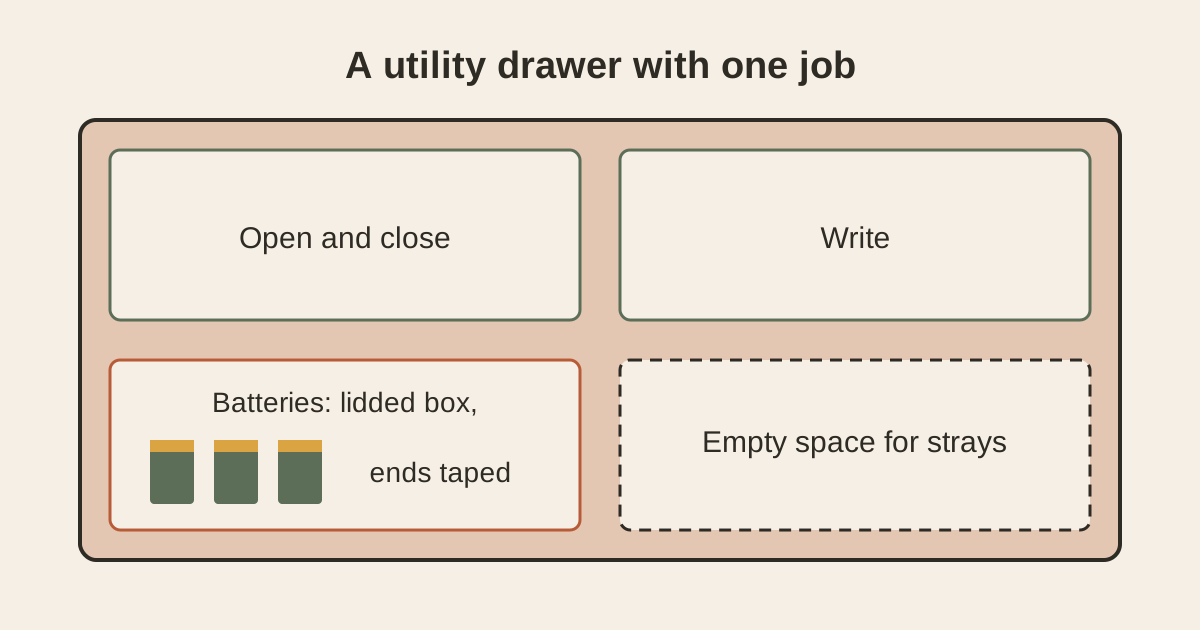
Group the survivors by the job they do. Most kitchen junk drawers come down to a handful of groups: open and close, write, fix and measure, and power (batteries in a lidded box).
Measure the drawer’s inside width, depth, and height after you sort, so you buy bins for what you’re keeping instead of what you used to have. Put the most-used group at the front.
Leave some empty space. A drawer packed edge to edge on day one has nowhere to absorb next week’s stray item, and that stray ends up stacked on top of everything else.
Step 4: Tie the weekly check to a cue
A “remember to check the drawer” plan rarely survives a busy month. Habit research suggests why. In a 2012 paper in the British Journal of General Practice, habit researchers explain that repeating a simple action in a consistent context links it to cues in that context, until the cue starts the action on its own. Their advice is to plan exactly when and where you’ll do it.
So attach the check to something you already do every week:
- “After I put the groceries away on Saturday, I check the drawer against the list.”
- “When I take the recycling out, I pull visitors and dead batteries from the drawer.”
The paper also notes you can’t form a habit of not doing something. “Stop tossing things in the drawer” won’t stick. “Pull out anything not on the list after the groceries” can.
The check itself is short: pull out visitors, dried-out pens, and spent batteries (lithium-ion and button cells taped and bagged for the drop-off, not the trash). It fits inside a 15-minute weekly home reset if you already do one.
Keeping it from sliding back
- Give the true miscellany its own box. Spare keys, the cable you might need, a single earring: put them in a small labeled box in a cabinet, not the daily drawer. That keeps scissors and tape from getting buried.
- Don’t add a second drawer. The drawer expands to fill whatever space you give it. A drawer that’s slightly too small forces regular edits.
- Handle incoming items once. Many strays arrive as “I’ll put it away later.” The one-touch rule covers that habit.
- Give keys their own home. If the drawer keeps collecting keys and wallets, they need a spot by the door instead. Here’s how to set up a drop zone that sticks.
If the whole kitchen feels like this drawer, don’t tackle it all at once. Start with one drawer and let the win carry over.
FAQ
Should I get rid of the junk drawer entirely?
You can, but one small, deliberately limited drawer with a keep-list is usually easier to live with than forcing every odd item into a category somewhere else. The aim is containment. One contained drawer beats strays spreading across counters.
Can I throw old batteries in the trash?
Lithium-ion and button batteries, no. Take them to a battery drop-off with the terminals taped. Ordinary alkaline batteries are allowed in household trash in most communities, according to the EPA, but some states ban it, and EPA recommends recycling them either way.
Why does the drawer look fine after organizing and then fill up again?
Organizers control where things sit, not what comes in. Without a written job for the drawer and a regular check, new strays have nowhere else to go, so they land in the one drawer that takes anything.
Sources
- Used Household Batteries (US EPA) — taping terminals and bagging batteries, lithium spark risk, button cells away from children, alkaline disposal, Earth911 and Call2Recycle
- Battery Fire Safety (U.S. Fire Administration) — storing spare lithium-ion batteries, warning signs, no lithium-ion in the trash
- Button Battery Ingestion (Poison Control) — 3,500 US ingestions a year, damage within 2 hours, the battery ingestion hotline
- Making health habitual (British Journal of General Practice, 2012) — habits form by repeating an action after a consistent cue; you can’t build a habit of not doing something
- Harvard Health: Forgetfulness: 7 types of normal memory problems and 7 ways to keep your memory sharp — absentmindedness, and designating a place for everyday items
Written and reviewed by peter.bae for Hearth & Habit · Last reviewed October 11, 2026


Comments
Post a Comment