How to Stop Losing Your Keys Every Morning: The Drop-Zone Fix
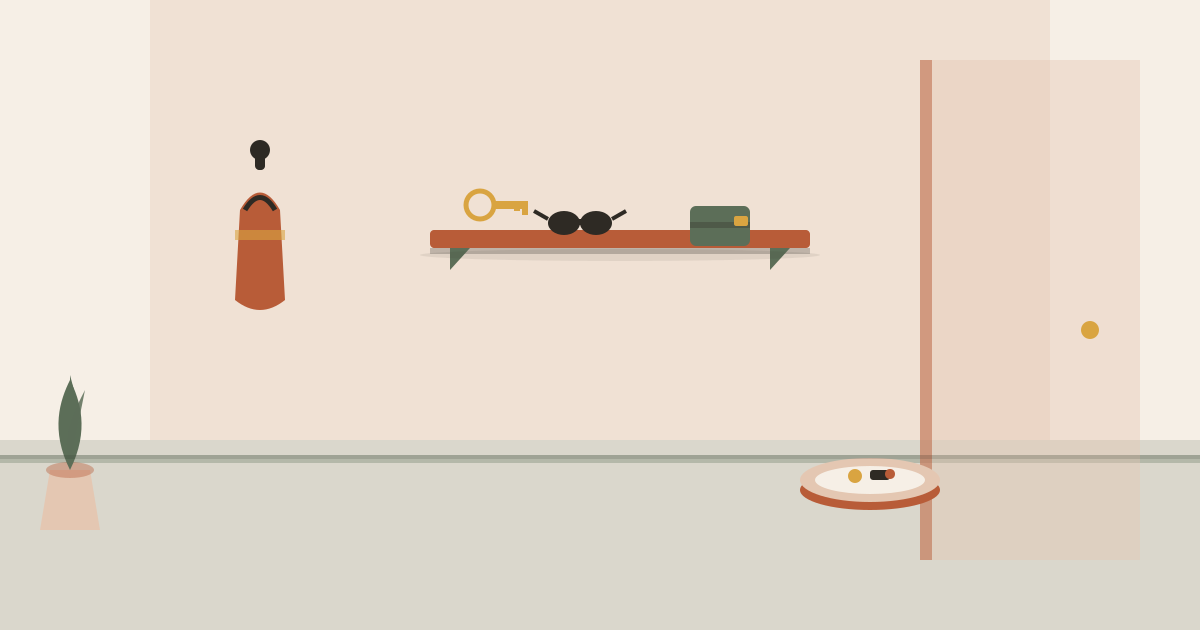
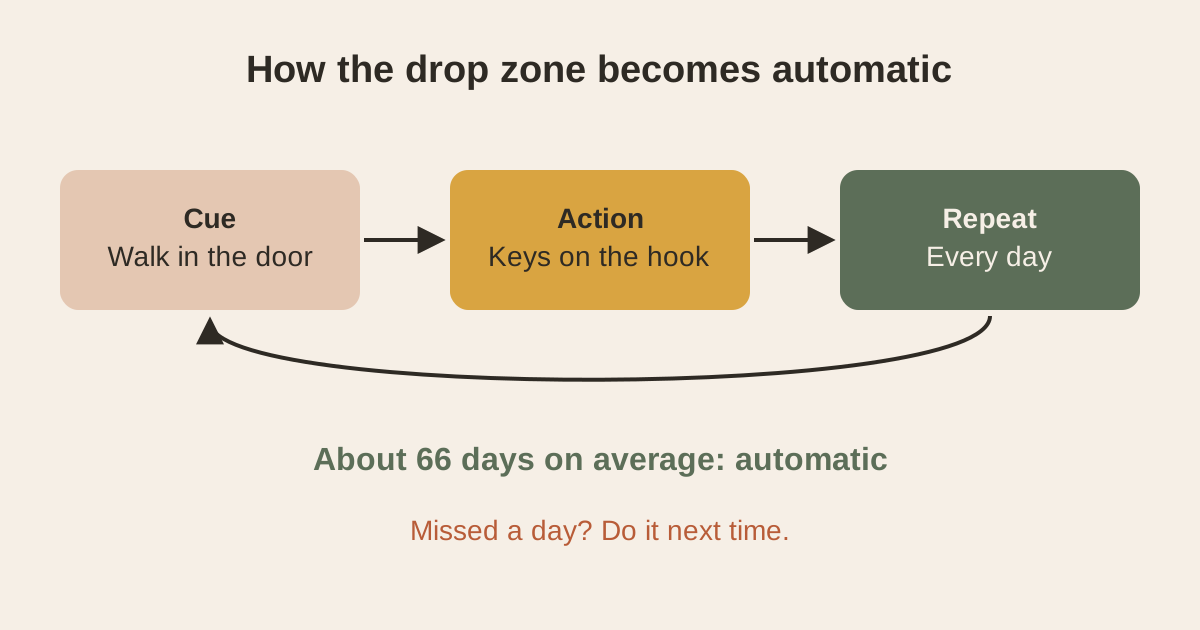
Give your keys and the few other things you hunt for one fixed spot by the door you actually use, and put them there every time you walk in. Habit research puts the point where that becomes automatic at about 66 days on average, and missing the occasional day along the way doesn’t seriously set it back.
That timeline is the part most drop-zone advice leaves out. People build a nice entry shelf, use it for a week or two, slip, and decide the system failed. Below is why the searching happens, what the research says about making the hook stick, and a 10-week plan built on it.
Why you lose the same things every morning
Harvard Health Publishing lists absentmindedness as one of seven normal kinds of forgetting. It happens when you don’t pay close enough attention as you put something down. You were thinking about something else, so your brain never stored where the keys went. There’s little to “remember harder” the next morning, because the location was never securely stored.
That explains why a tidy house alone doesn’t fix it. Keys on a clean counter, in a coat pocket, or on the bathroom shelf are just as lost as keys under a pile, if you didn’t notice setting them there.
Harvard Health’s fix is direct: designate a place at home for your glasses, purse, keys, and other items you use often. A fixed spot means there’s nothing to encode. You only have to check one place.
Harvard Health files a second problem under the same heading: forgetting to do something at a set time. The library book that needed to go back today, the signed permission slip. That’s what the “outgoing” spot in step 4 below is for.
What habit research says about making it stick
A shelf by the door only solves half the problem. The other half is putting things on it without thinking. In a 2012 paper in the British Journal of General Practice, Gardner, Lally, and Wardle summarize how that kind of automatic behavior forms:
- Repetition in the same context does the work. Repeating a simple action in a consistent setting links the action to cues in that setting, until the cue starts the action on its own.
- It takes longer than three weeks, on average. In the study they describe, people repeated one chosen action after a single daily cue, such as “after breakfast.” Automaticity rose, then leveled off after an average of 66 days.
- Simple actions get there faster. Automaticity peaked sooner for simple actions than for elaborate routines.
- A missed day is not a reset. Missing the occasional opportunity did not seriously impair habit formation, and progress resumed after one missed day.
- It has to be something you do. The authors note that it’s not possible to form a habit of not doing something.
That last point changes how you phrase the goal. “Stop dropping my keys on the counter” can’t become a habit. “When I walk in the door, I hang my keys on the hook” can.
The paper’s tool for patients follows the same steps. Choose one simple action. Plan exactly when and where you’ll do it, picking a time and place you meet every day. Do it every time you meet that cue. It says you should find yourself doing it automatically within 10 weeks.
Set up the zone so the action is simple
Put it where you actually come in
The cue is walking through the door, so the zone has to sit right at the door you use every day. If you come in through the garage, it goes by the garage door, even if the front entry looks nicer. A zone two rooms away isn’t tied to the cue, so it has nothing to become automatic around.
One home per item, sized to fit
Simple actions become automatic faster, so make each drop a single motion:
| Item | Home | Why this shape |
|---|---|---|
| Keys | A hook per person, at hand height | Hanging is one motion; no drawer to open |
| Wallet and phone | A shallow tray sized for just those | Too small to collect other clutter |
| Bag or backpack | Its own hook or a set spot on a bench | Off the floor, where it gets kicked aside |
| Daily shoes | A mat or low rack at the door | Only shoes in use this week |
| Items that leave tomorrow | A separate “outgoing” basket | Emptied every day, so it can’t fill up |
A single big bowl for “door stuff” tends to turn into a junk pile, for the same reason kitchen drawers keep becoming junk drawers: anything can go in, so everything does.
The 10-week plan
| When | What you do | Based on |
|---|---|---|
| Days 1–3 | Note everything you hunt for on the way out | Find which items need a home |
| Day 4 | Build the zone at the door you use; one home per item | Harvard Health: a designated place |
| Day 4 | Write each habit as “When I walk in, I ___” and tape the list at the zone | BJGP: plan when and where |
| Weeks 1–10 | Do the action every time you walk in | BJGP: repeat after the same daily cue |
| Week 2 | Move any home that keeps getting skipped closer to where your hands are | Keep each action simple |
| Any day you miss | Do it next time; don’t start over | BJGP: one miss didn’t seriously impair progress |
| About day 66 | Take the list down if you no longer read it | BJGP: average plateau at 66 days |
| Week 10 | Check whether the hook happens without thinking | BJGP tool: automatic within 10 weeks |
Two notes on that plan. Sixty-six days is an average, and the paper reports the timing differed by how simple the action was, so yours may come sooner or later. And add new habits one at a time. Get keys automatic first, then attach the wallet tray to the same cue.
When one item keeps escaping
| What keeps happening | Likely reason | Fix |
|---|---|---|
| Keys end up in a coat pocket | The coat comes off before you reach the hook | Put the hook where the coat comes off |
| Phone stays in your hand | You’re using it as you walk in | Make the tray the phone’s charging spot |
| One person never uses it | No spot of their own | Give each person a labeled hook |
| Kids’ things land on the floor | The hooks are too high to reach | Add a low hook or shelf at their height |
| The tray fills with receipts and mail | It’s big enough to hold anything | Swap in a tray that fits only wallet and phone |
| Forgotten items happen on specific days | It’s a timing problem, not a location problem | Stage tomorrow’s items in the outgoing basket the night before |
The outgoing basket handles the “forgot to do it on the day” kind of absentmindedness. If a signed form or a library book goes in there the evening before, the cue (walking out the door) brings it with you.
Keeping it working
A quick reset helps on days the zone gets messy. Fold it into the 15-minute weekly home reset rather than adding another chore. The same principle is behind the one-touch rule: handle an item once, putting it where it lives instead of somewhere for now.
If the zone sits in a cluttered entryway, start with one shelf or one drawer rather than reorganizing the whole area at once. Here’s how to start with one drawer when you’re overwhelmed.
FAQ
Is constantly losing my keys a sign of a memory problem?
The Alzheimer’s Association describes misplacing things from time to time and retracing your steps to find them as a typical age-related change. The warning sign it lists is different: putting things in unusual places and being unable to retrace steps to find them. MedlinePlus advises seeing a health care provider if you’re worried about forgetfulness.
Why did the drop zone work for two weeks and then stop?
Two weeks is early. In the study Gardner and colleagues describe, automaticity kept climbing well past that on average, leveling off after an average of 66 days. Keep doing the action at the same cue, and treat a slip as a missed day, not a failure.
How do I get the rest of the household to use it?
Give each person their own hook or tray so it’s clearly theirs, and keep each person’s habit to one action at first. The same habit rules apply to everyone: one cue, one simple action, repeated daily.
Sources
- Making health habitual: the psychology of habit-formation and general practice (British Journal of General Practice, 2012) — context-dependent repetition, 66-day average, missed days, simple vs. complex actions, the 10-week planning tool
- Forgetfulness: 7 types of normal memory problems (Harvard Health) — absentmindedness as an attention problem, including forgetting to do things at a set time
- 7 ways to keep your memory sharp at any age (Harvard Health) — designate a place for keys and everyday items
- 10 Early Signs and Symptoms of Alzheimer’s and Dementia (Alzheimer’s Association) — typical misplacing vs. the warning sign
- Memory (MedlinePlus) — see a provider if you’re worried about forgetfulness
Written and reviewed by peter.bae for Hearth & Habit · Last reviewed October 11, 2026


Comments
Post a Comment